Finding the Right Balance in a Fast-Paced World: Creating Life Balance in the Digital Age
DOI:
https://doi.org/10.65680/jahs.v1i1.6716Keywords:
Right balance, Life balance, Digital age, Mindfulness, Sustainable developmentAbstract
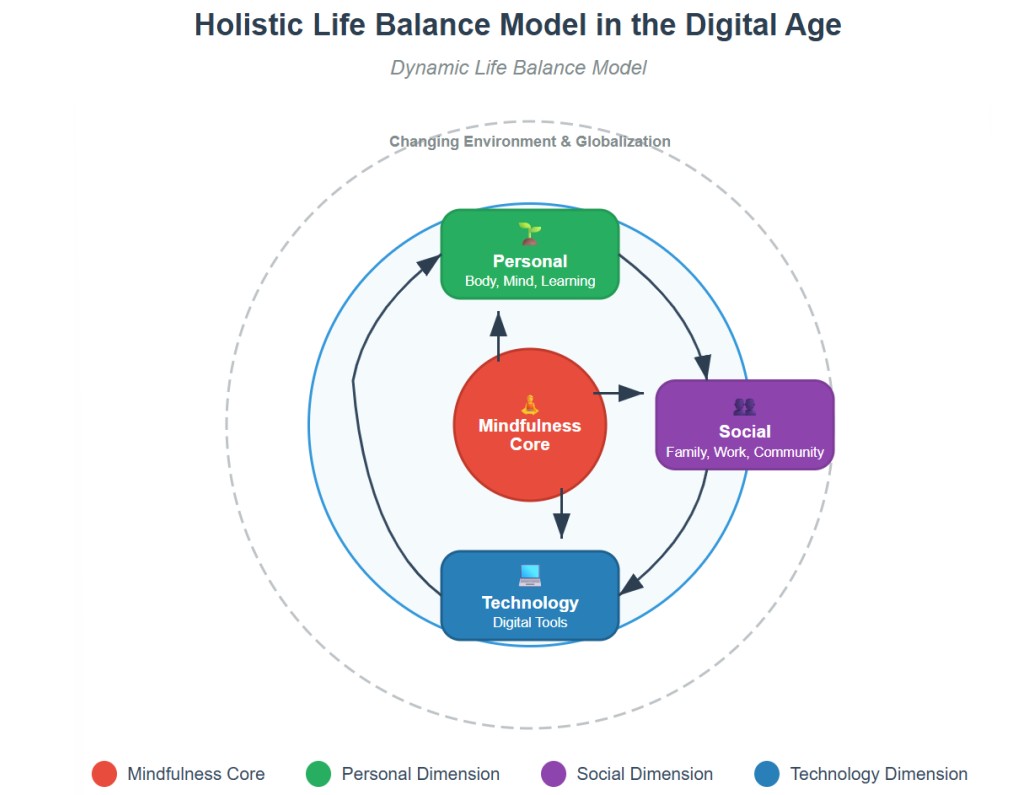
Living in an era of rapid technological advancement and continuous social change presents unprecedented challenges for individuals seeking to create balance between the urgency of modern life and fundamental human needs for meaningful and quality existence. This article presents an analysis of the concept of "finding the right balance" in the context of contemporary Thai society through an integrative framework combining Buddhist philosophy, modern psychology, and sustainable development concepts. The study demonstrates that finding the "right balance" is not about escaping the pace of modern life but learning to live with it mindfully and creatively. Research findings indicate that effective approaches to creating life balance include developing mindfulness, effective time management, building quality relationships, and maintaining mental health through practices aligned with traditional Thai values while adaptable to the globalized context. The integration of ancient wisdom with modern knowledge, between speed and slowness, between connection and solitude, serves as a key to creating meaningful and sustainable life in an accelerated world.
References
Allen, D. (2001). Getting things done: The art of stress-free productivity. Viking.
Anālayo. (2003). Satipaṭṭhāna: The direct path to realization. Windhorse Publications.
Aristotle. (1999). Nicomachean ethics (T. Irwin, Trans.). Hackett Publishing. (Original work published ca. 350 B.C.E.)
Barrero, J. M., Bloom, N., & Davis, S. J. (2021). Why working from home will stick (Working Paper No. 28731). National Bureau of Economic Research. https://doi.org/10.3386/w28731
Bauman, Z. (2007). Liquid times: Living in an age of uncertainty. Polity Press.
Beck, A. T. (1976). Cognitive therapy and the emotional disorders. International Universities Press.
Bodhi, B. (Trans.). (2000). The connected discourses of the Buddha: A translation of the Saṃyutta Nikāya. Wisdom Publications.
Bonanno, G. A. (2004). Loss, trauma, and human resilience: Have we underestimated the human capacity to thrive after extremely aversive events? American Psychologist, 59(1), 20–28. https://doi.org/10.1037/0003-066X.59.1.20
Bowlby, J. (1988). A secure base: Parent-child attachment and healthy human development. Basic Books.
Brown, P. C., Roediger, H. L., III, & McDaniel, M. A. (2014). Make it stick: The science of successful learning. Harvard University Press.
Csikszentmihalyi, M. (1990). Flow: The psychology of optimal experience. Harper & Row.
Davidson, R. J., & Lutz, A. (2008). Buddha's brain: Neuroplasticity and meditation. IEEE Signal Processing Magazine, 25(1), 176–174. https://doi.org/10.1109/MSP.2008.4431873
Department of Mental Health, Ministry of Public Health, Thailand. (2019). Thailand mental health survey 2019. Department of Mental Health.
Duhigg, C. (2012). The power of habit: Why we do what we do in life and business. Random House.
Dunbar, R. I. M. (2016). Do online social media cut through the constraints that limit the size of offline social networks? Royal Society Open Science, 3(1), Article 150292. https://doi.org/10.1098/rsos.150292
Dweck, C. S. (2006). Mindset: The new psychology of success. Random House.
Firth, J., Torous, J., Nicholas, J., Carney, R., Pratap, A., Rosenbaum, S., & Sarris, J. (2017). The efficacy of smartphone-based mental health interventions for depressive symptoms: A meta-analysis of randomized controlled trials. World Psychiatry, 16(3), 287–298. https://doi.org/10.1002/wps.20472
Florida, R. (2017). The new urban crisis: How our cities are increasing inequality, deepening segregation, and failing the middle class—and what we can do about it. Basic Books.
Garland, E. L., Farb, N. A., Goldin, P. R., & Fredrickson, B. L. (2015). Mindfulness broadens awareness and builds eudaimonic meaning: A process model of mindful positive emotion regulation. Psychological Inquiry, 26(4), 293–314. https://doi.org/10.1080/1047840X.2015.1064294
Goleman, D. (1995). Emotional intelligence: Why it can matter more than IQ. Bantam Books.
Goleman, D., & Davidson, R. J. (2017). Altered traits: Science reveals how meditation changes your mind, brain, and body. Avery.
Gottman, J. M. (2015). The seven principles for making marriage work (Rev. ed.). Harmony Books.
Greenhaus, J. H., & Powell, G. N. (2006). When work and family are allies: A theory of work-family enrichment. Academy of Management Review, 31(1), 72–92. https://doi.org/10.5465/amr.2006.19379625
Hewison, K. (2000). Thailand's capitalism: Development through boom and bust. In R. Robison, M. Beeson, K. Jayasuriya, & H.-R. Kim (Eds.), Politics and markets in the wake of the Asian crisis (pp. 71–103). Routledge.
Jenkins, H., Ito, M., & Boyd, D. (2016). Participatory culture in a networked era: A conversation on youth, learning, commerce, and politics. Polity Press.
Johnson, C. (2012). The information diet: A case for conscious consumption. O'Reilly Media.
Kabat-Zinn, J. (2003). Mindfulness-based interventions in context: Past, present, and future. Clinical Psychology: Science and Practice, 10(2), 144–156. https://doi.org/10.1093/clipsy.bpg016
Knowles, M. S. (1975). Self-directed learning: A guide for learners and teachers. Association Press.
Miller, G. A. (1956). The magical number seven, plus or minus two: Some limits on our capacity for processing information. Psychological Review, 63(2), 81–97. https://doi.org/10.1037/h0043158
Neff, K. D. (2011). Self-compassion: The proven power of being kind to yourself. William Morrow.
Newport, C. (2016). Deep work: Rules for focused success in a distracted world. Grand Central Publishing.
Paul, R., & Elder, L. (2006). Critical thinking: Tools for taking charge of your learning and your life (2nd ed.). Pearson Prentice Hall.
Piboolsravut, P. (2004). Sufficiency economy. ASEAN Economic Bulletin, 21(1), 127–134. https://doi.org/10.1355/AE21-1H
Primack, B. A., Shensa, A., Escobar-Viera, C. G., Barrett, E. L., Sidani, J. E., Colditz, J. B., & James, A. E. (2017). Use of multiple social media platforms and symptoms of depression and anxiety: A nationally-representative study among U.S. young adults. Computers in Human Behavior, 69, 1–9. https://doi.org/10.1016/j.chb.2016.11.013
Putnam, R. D. (2000). Bowling alone: The collapse and revival of American community. Simon & Schuster.
Riches, S., Azevedo, L., Bird, L., Pisani, S., & Valmaggia, L. (2021). Virtual reality relaxation for the general population: A systematic review. Social Psychiatry and Psychiatric Epidemiology, 56(10), 1707–1727. https://doi.org/10.1007/s00127-021-02110-z
Robinson, J. P., & Godbey, G. (2019). Time for life: The surprising ways Americans use their time (3rd ed.). Pennsylvania State University Press.
Rosa, H. (2013). Social acceleration: A new theory of modernity. Columbia University Press.
Rosenberg, M. B. (2003). Nonviolent communication: A language of life (2nd ed.). PuddleDancer Press.
Sapolsky, R. M. (2004). Why zebras don't get ulcers (3rd ed.). Times Books.
Seligman, M. E. P. (2011). Flourish: A visionary new understanding of happiness and well-being. Free Press.
Selye, H. (1978). The stress of life (Rev. ed.). McGraw-Hill.
Sherman, N. (1989). The fabric of character: Aristotle's theory of virtue. Oxford University Press.
Siemens, G. (2005). Connectivism: A learning theory for the digital age. International Journal of Instructional Technology and Distance Learning, 2(1), 3–10.
Thich Nhat Hanh. (1999). The miracle of mindfulness: An introduction to the practice of meditation. Beacon Press.
Twenge, J. M., & Campbell, W. K. (2018). Associations between screen time and lower psychological well-being among children and adolescents: Evidence from a population-based study. Preventive Medicine Reports, 12, 271–283. https://doi.org/10.1016/j.pmedr.2018.10.003
Ulrich, R. S. (1984). View through a window may influence recovery from surgery. Science, 224(4647), 420–421. https://doi.org/10.1126/science.6143402
Walker, M. (2017). Why we sleep: Unlocking the power of sleep and dreams. Scribner.
Downloads
Published
How to Cite
Issue
Section
License
Copyright (c) 2023 Journal of Applied Humanities Studies

This work is licensed under a Creative Commons Attribution 4.0 International License.
Published articles are copyrighted by the Journal of Applied Humanities Studies.
The contents of each article in this academic journal represent the personal opinions of the individual authors and are not affiliated with the Journal of Applied Humanities Studies or any other editorial team within the publishing house. The responsibility for all content of each article rests with the individual authors. Any errors or omissions are solely the responsibility of each individual author.