A Study on the Development of Legal Measures for the Prevention and Suppression of Cybercrime to Address Future Technological Crimes
Keywords:
AI (Artificial Intelligence), Deepfake, CybercrimeAbstract
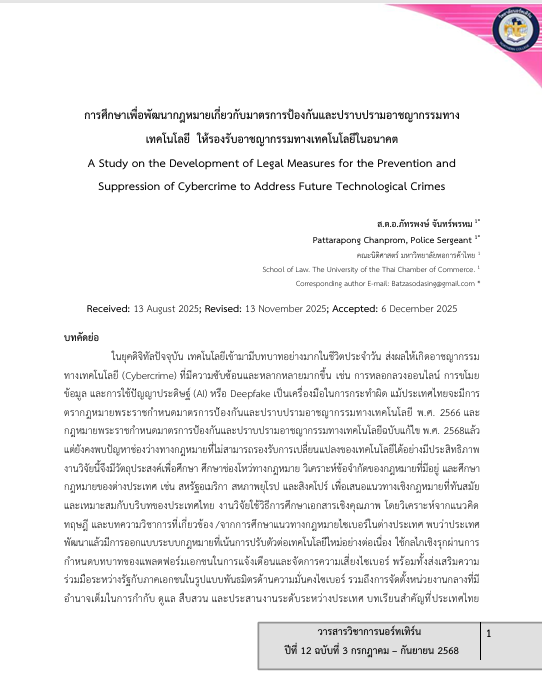
In the current digital era, technology plays a significant role in daily life, leading to increasingly complex and diverse forms of cybercrime such as online fraud, data theft, and the misuse of artificial intelligence (AI) and deepfake technologies for criminal purposes. Although Thailand has enacted the Royal Decree on Measures for the Prevention and Suppression of Technology Crime B.E. 2566 (2023) and its amendment in B.E. 2568 (2025), there remain legal gaps that hinder the law’s ability to effectively keep pace with rapid technological advancements. This research aims to explore these legal loopholes, analyze the limitations of existing laws, and study international legal frameworks such as those in the United States, the European Union, and Singapore. The objective is to propose modern and context-appropriate legal approaches for Thailand. This study employs qualitative document analysis, drawing on relevant theories, academic articles, and legal concepts. The findings are expected to offer recommendations for enhancing Thai legislation to be more flexible and up-to-date, capable of addressing future cybercrimes, and fostering public and business confidence in using technology safely and sustainably/ From the study of international approaches to cyber law, it has been found that developed countries design their legal systems to continuously adapt to new technologies. They employ proactive mechanisms by defining the roles of private platforms in alerting and managing cyber risks, while also promoting collaboration between the public and private sectors through cyber security partnerships. In addition, these countries have established central agencies with full authority to regulate, supervise, investigate, and coordinate at the international level.
The key lesson that Thailand can apply is to enhance its legal framework to be more flexible and responsive to technological changes in a timely manner, as well as to promote proactive mechanisms at the policy, platform, and international cooperation levels. This would enable the country to effectively and sustainably address cyber threats in the long term.
Therefore, Thailand should systematically revise and develop policies across multiple dimensions, beginning with the amendment of legal provisions to make them more comprehensive and explicit — particularly by defining crimes related to AI and Deepfake technologies in legal terms. For example, acts such as impersonation through Deepfake technology or the creation of deceptive content using automated systems should be clearly defined as offenses. Establishing clear definitions and legal bases for such crimes will help prevent ambiguity in law enforcement and allow the justice system to respond promptly.
Furthermore, a specialized AI Crime Unit should be established under the Royal Thai Police It refers to the development of the potential and capabilities of personnel involved in the justice process, including police officers, investigators, and digital forensic experts Thailand should promote the establishment of an “ASEAN Committee on Cooperation for Combating Cybercrime.”
References
ชนลดา อินบุตร. (2567). ปัญหาความมั่นคงไซเบอร์และความร่วมมือในการแก้ปัญหา. จาก https://so16.tci-thaijo.org/index.php/SJ_SS/article/view/380.
ตำรวจภูธรภาค 9. (2567). สถิติเหยื่ออาชญากรรมไซเบอร์. จาก https://www.police9.go.th/สถิติเหยื่ออาชญากรรมไซเบอร์.
ธันย์ธรณ์เทพ แย้มอุทัย. (2568). การศึกษาปัญหาและอุปสรรคของกฎหมายและนโยบายที่เกี่ยวข้องกับมาตรการป้องกันและปราบปรามอาชญากรรมทางเทคโนโลยี. จาก https://so06.tci-thaijo.org/index.php/mcjou/article/view/276367.
ธิติรัตน์ สมบูรณ์ (2566). รู้ เข้าใจและตระหนัก “อาชญากรรมทางไซเบอร์” (Cybercrime) ป้องกันภัยคุกคามใกล้ตัว. จาก https://www.chula.ac.th/news/138291/.
ธนาคารแห่งประเทศไทย. https://www.bot.or.th/th/satang-story/fraud/call-center.htm.
ปิยอร เปลี่ยผดุง. (2567). กฎหมายและหน่วยงานที่เกี่ยวข้องกับการบังคับใช้ในการควบคุม ป้องกัน และปราบปรามอาชญากรรมทางการเงินออนไลน์ในประเทศไทย. จาก https://www.econ.chula.ac.th/download/research/Nualnoi/03-final.pdf.
พระราชกำหนดมาตรการป้องกันและปราบปรามอาชญากรรมทางเทคโนโลยี พ.ศ. 2566. 20230323_094210_105_13452642.pdf.
พระราชกำหนดมาตรการป้องกันและปราบปรามอาชญากรรมทางเทคโนโลยี พ.ศ. 2568 ฉบับที่ 2. https://ratchakitcha.soc.go.th/documents/67320.pdf.
วาสิน มีธรรม และบัณฑิต ขวาโยธา (2564). ปัญหาการบังคับใช้กฎหมายตามพระราชบัญญัติว่าด้วยการ กระทําผิดเกี่ยวกับคอมพิวเตอร์ ฉบับที่ 2 พ.ศ.2560. วารสารปัญญาปณิธาน. 6(1) , 135-146.
สถานีโทรทัศน์สำนักงานตำรวจแห่งชาติ. (2566). สำนักงานตำรวจแห่งชาติ เตือนภัยการฉ้อโกงใน โลกไซเบอร์อาจส่งผลกระทบ ต่อสาเหตุการเกิดอาชญากรรมที่เกี่ยวข้องกับชีวิต ร่างกายและทรัพย์สินในชีวิตประจำวันได้. จาก https://policetv.tv/archives/20228.
สรวิศ บุญมี. (2566). ภัยแก๊งคอลเซ็นเตอร์จากอาชญากรรมทางเศรษฐกิจสู่อาญากรรมทำงเทคโนโลยี. วารสารวิชาการมหาวิทยาลัยอีสเทิร์นเอเชีย 17( 2), 19-26.
สัจจะ โชคบุญส่งสวัสดิ์. (2566). แนวทางการเพิ่มประสิทธิภาพในการตัดวงจรอาชญากรรมออนไลน์. จาก https://www.ocsc.go.th/?attachment_id=87343&.
สำนักงานตำรวจแห่งชาติ.(2566). รายงานสถิติการหลอกลวงทางออนไลน์ 1 มีนาคม 2565- 31 พฤษภาคม 2566. ออนไลน์. สืบค้นเมื่อ 8 สิงหาคม 2566. แหล่งที่มา http://www.thaipoliceonline.com.
สำนักงานส่งเสริมเศรษฐกิจดิจิทัล. (2566). เทคโนโลยีที่สำคัญในยุคดิจิทัล: เทคโนโลยีปัญญาประดิษฐ์ Tech Series: Artificial Intelligence (AI). จาก https://www.depa.or.th/th/article- view/tech-series-artificial-intelligence.
อภิชาติ บวบขม. (2566). ปัญหาทางกฎหมายในการสอบสวนความผิดเกี่ยวกับอาชญากรรมทางเทคโนโลยี. จาก. https://so02.tci-thaijo.org/index.php/JRKSA/article/download/266556/178800/1096195?.
อาริยา สุขโต. (2565). ภัยอาชญากรรมแก๊งคอลเซ็นเตอร์. จาก https://library.parliament.go.th/th/radioscript/rr2565-jul7.
Halder, Debarati, Jaishankar, Karuppannan, & Jaishankar, K. (2012). Cyber crime and the victimization of women: laws, rights and regulations: Information Science ReferenceIllinois General Assembly. (1999). Illinois Right of Publicity Act (765 ILCS 1075). Retrieved from https://www.ilga.gov/legislation/ilcs/ilcs3.asp?ActID=2271&ChapterID=64.
Meland, H.P., Tokas,S., Erdogan, G., Bernsmed,K. & Omerovic,A.(2021) A Systematic mapping study on cyber security indicator data. Electronics. 10, e1092. https://doi.org/10.3390/electronics10091092.
New York State Senate. (2020). Civil Rights Law § 50-f: Prohibited use of a deceased individual’s persona for commercial purposes. Retrieved from https://www.nysenate.gov/legislation/laws/CVR/50-F.
Shelly, G., & Vermaat, M. (2010). Discovering Computers 2011: Complete: Cengage Learning.Virginia General Assembly. (2019). § 8.01-42.6. Unauthorized dissemination of sexually explicit images or video. Retrieved from https://law.lis.virginia.gov/vacode/title8.01/chapter3/section8.01-42.6/.
Downloads
Published
How to Cite
Issue
Section
License

This work is licensed under a Creative Commons Attribution-NonCommercial-NoDerivatives 4.0 International License.