
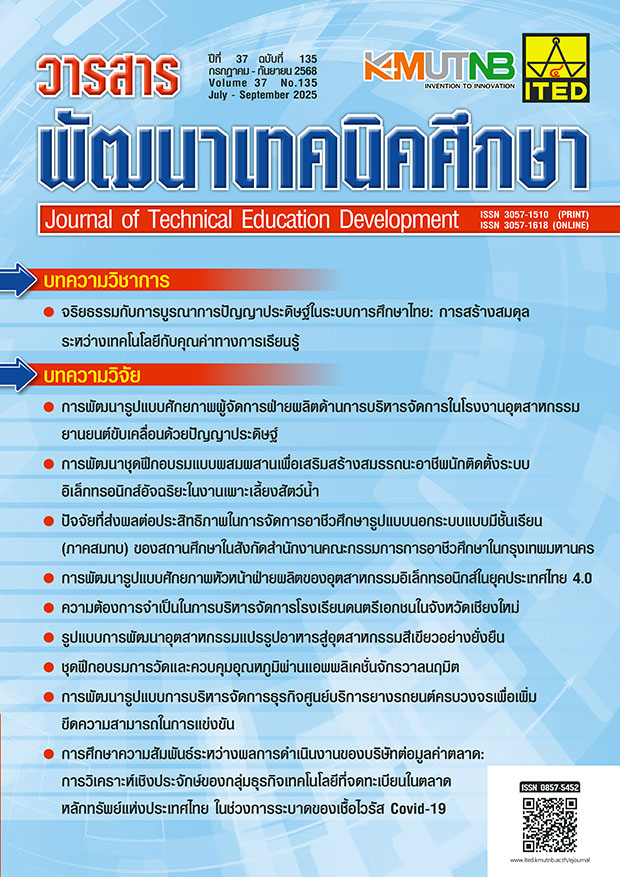
Ethics and the Integration of Artificial Intelligence in the Thai Education System: Balancing Technology and Educational Values
Article Sidebar
Main Article Content
Abstract
This article focuses on analyzing the integration of Artificial Intelligence (AI) into the Thai education system, emphasizing ethical considerations associated with its application in areas such as personalized assessment, curriculum design tailored to individual needs, and interactive learning enhancement. While AI holds the potential to improve educational efficiency, significant challenges remain, including privacy protection, algorithmic bias management, and avoiding over-reliance on technology. The discussion extends to Thailand's ethical AI governance framework and alignment with international standards. This study highlights the need to balance innovation and ethical principles, ensuring AI serves as a tool to enhance learning and foster critical skills among youth in the digital era.
Article Details

This work is licensed under a Creative Commons Attribution-NonCommercial-NoDerivatives 4.0 International License.
References
Aung, Z. H., Sanium, S., Songsaksuppachok, C., Kusakunniran, W., Precharattana, M., Chuechote, S., Pongsanon, K., & Ritthipravat, P. (2022). Designing a novel teaching platform for AI: A case study in a Thai school context. Journal of Computer Assisted Learning, 38(6), 1714–1729. https://doi.org/10.1111/jcal.12706
The Study Abroad Portal. (2024). The impact of the Thai education system on student success. https://thestudyabroadportal.com/studyabroadblog/the-impact-of-the-thai-education-system-on-student-success/
Better Living Asia. (n.d.). Exploring the education culture in Thailand. https://betterlivingasia.com/education-culture-in-thailand/
NSTDA. (2023). NSTDA unveils one-year progress report on the implementation of National AI Strategy and Action Plan. https://shorturl.asia/FapIB
Digital Policy Alert. (2023). Thailand: Published annual report 2023 on the National AI Strategy. https://www.digitalpolicyalert.org/thailand-2023-ai-strategy
The Nation. (2024). AI compliance and innovation: Navigating personal data regulations in Thailand. https://www.nationthailand.com/blogs/business/tech/40040467
European Union, Thailand. (2024). Current stage of Thailand’s regulatory approach to AI. https://shorturl.asia/Y8NuX
Tech for Good Institute. (2024). Shaping the digital future: Regulatory updates from Thailand. https://shorturl.asia/7Ougt
Dergaa, I., Chamari, K., Zmijewski, P., & Ben Saad, H. (2023). From human writing to artificial intelligence generated text: Examining the prospects and potential threats of ChatGPT in academic writing. Biology of Sport, 40(2), 615–622. https://doi.org/10.5114/biolsport.2023.125623
Carvalho, D. V., Pereira, E. M., & Cardoso, J. S. (2019). Machine learning interpretability: A survey on methods and metrics. Electronics, 8(8), Article 832. https://doi.org/10.3390/electronics8080832
Abd-alrazaq, A., AlSaad, R., Alhuwail, D., Ahmed, A., Healy, P. M., Latifi, S., Aziz, S., Damseh, R., Alabed Alrazak, S., & Sheikh, J. (2023). Large language models in medical education: Opportunities, challenges, and future directions. JMIR Medical Education, 9, e48291. https://doi.org/10.2196/48291
So, S. (2023). How artificial intelligence (AI) is important for Thai education. https://shorturl.asia/H84gF
Tiya, V. (2023). How AI can solve the education system: Thailand case study. https://shorturl.asia/SUqKaUNESCO. (2022). Future of AI in Thai education. https://anyflip.com/bpnjl/dhru/basic
Zhai, C., Wibowo, S., & Li, L. D. (2024). The effects of over-reliance on AI dialogue systems on students' cognitive abilities: A systematic review. Smart Learning Environments, 11(28), 1–15. https://doi.org/10.1186/s40561-024-00316-7
UNESCO. (2022). Future of AI in Thai education. https://anyflip.com/bpnjl/dhru/basic
Culican, J. (2023). [Online]. Concerns and Data Security: Navigating the Complex Landscape. [Accessed on November 20, 2024]. Available from: https://shorturl.asia/1jUOC
Chulalongkorn University. (2024). Chula pioneers responsible use of generative AI for higher education in Thailand with the inauguration of ‘ChulaGENIE,’ in collaboration with Google Cloud. https://www.chula.ac.th/en/highlight/203964/
Somboon, T. (2023). The AI era is here. Is Thailand ready for it? Chula is all set for change and introduces generative AI. https://www.chula.ac.th/en/highlight/130512/
Teachflow. (2023). The ethical implications of AI in the classroom. https://teachflow.ai/the-ethical-implications-of-ai-in-the-classroom/
Evaristo, E., & McQuiston, P. (2024). How teachers make ethical judgments when using AI in the classroom. https://today.usc.edu/ai-in-the-classroom-how-teachers-make-ethical-judgments/
The Story Thailand. (2024). The right to privacy: Protecting personal data in the AI age. https://www.thestorythailand.com/en/29/01/2024/122359/
Wutiwiwatchai, C. (2022). Thailand’s AI strategy to boost economic and social wellbeing. https://oecd.ai/en/wonk/thailand-ai-strategy
