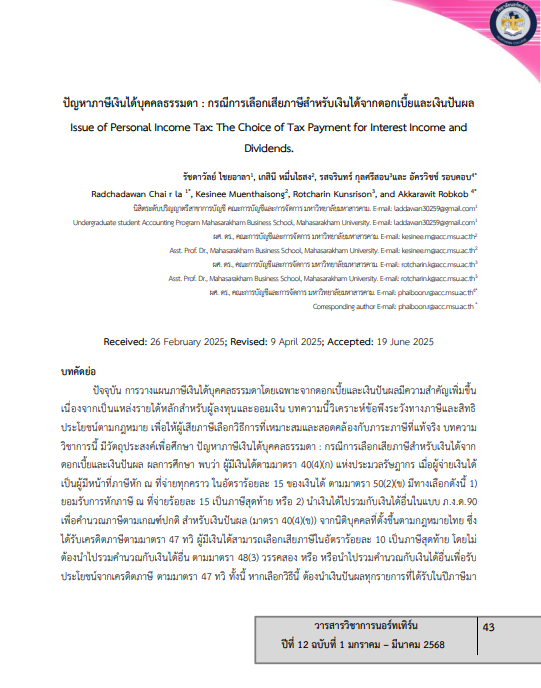
ปัญหาภาษีเงินได้บุคคลธรรมดา : กรณีการเลือกเสียภาษีสำหรับเงินได้จากดอกเบี้ยและเงินปันผล
คำสำคัญ:
เงินปันผล, ดอกเบี้ย, ปัญหาภาษี, ภาษีสุดท้ายบทคัดย่อ
ปัจจุบัน การวางแผนภาษีเงินได้บุคคลธรรมดาโดยเฉพาะจากดอกเบี้ยและเงินปันผลมีความสำคัญเพิ่มขึ้น เนื่องจากเป็นแหล่งรายได้หลักสำหรับผู้ลงทุนและออมเงิน บทความนี้วิเคราะห์ข้อพึงระวังทางภาษีและสิทธิประโยชน์ตามกฎหมาย เพื่อให้ผู้เสียภาษีเลือกวิธีการที่เหมาะสมและสอดคล้องกับภาระภาษีที่แท้จริง บทความวิชาการนี้ มีวัตถุประสงค์เพื่อศึกษา ปัญหาภาษีเงินได้บุคคลธรรมดา : กรณีการเลือกเสียภาษีสำหรับเงินได้จากดอกเบี้ยและเงินปันผล ผลการศึกษา พบว่า ผู้มีเงินได้ตามมาตรา 40(4)(ก) แห่งประมวลรัษฎากร เมื่อผู้จ่ายเงินได้เป็นผู้มีหน้าที่ภาษีหัก ณ ที่จ่ายทุกคราว ในอัตราร้อยละ 15 ของเงินได้ ตามมาตรา 50(2)(ข) มีทางเลือกดังนี้ 1) ยอมรับการหักภาษี ณ ที่จ่ายร้อยละ 15 เป็นภาษีสุดท้าย หรือ 2) นำเงินได้ไปรวมกับเงินได้อื่นในแบบ ภ.ง.ด.90 เพื่อคำนวณภาษีตามเกณฑ์ปกติ สำหรับเงินปันผล (มาตรา 40(4)(ข)) จากนิติบุคคลที่ตั้งขึ้นตามกฎหมายไทย ซึ่งได้รับเครดิตภาษีตามมาตรา 47 ทวิ ผู้มีเงินได้สามารถเลือกเสียภาษีในอัตราร้อยละ 10 เป็นภาษีสุดท้าย โดยไม่ต้องนำไปรวมคำนวณกับเงินได้อื่น ตามมาตรา 48(3) วรรคสอง หรือ หรือนำไปรวมคำนวณกับเงินได้อื่นเพื่อรับประโยชน์จากเครดิตภาษี ตามมาตรา 47 ทวิ ทั้งนี้ หากเลือกวิธีนี้ ต้องนำเงินปันผลทุกรายการที่ได้รับในปีภาษีมารวมคำนวณ ไม่สามารถเลือกเฉพาะบางรายการได้ ความรู้จากบทความนี้ช่วยให้ผู้เสียภาษีวางแผนได้อย่างมีประสิทธิภาพ ลดความซับซ้อน และหลีกเลี่ยงข้อผิดพลาดในการคำนวณภาษีเงินได้บุคคลธรรมดา
เอกสารอ้างอิง
กรมสรรพากร, (2545ก) การเครดิตภาษีเงินปันผลหรือเงินส่วนแบ่งของกำไรตามมาตรา 47 ทวิ แห่งประมวลรัษฎากร. สืบค้นเมื่อวันที่ 24 กันยายน 2567 https://www.rd.go.th/11162.html
กรมสรรพากร, (2545ข) เงินได้พึงประเมินตามมาตรา 40(4)(ข) แห่งประมวลรัษฎากร. สืบค้นเมื่อวันที่ 24 กันยายน 2567 https://www.rd.go.th/11162.html
ธนาคารแห่งประเทศไทย. (2566). อัตราดอกเบี้ยเงินกู้แบบคงที่ อัตราดอกเบี้ยเงินกู้แบบลอยตัว. สืบค้นวันที่ 1 ตุลาคม 2567, https://www.bot.or.th/th/satang-story/managing-debt/interest.html.
วราพร เปรมพาณิชย์นุกูล. (2567). หนังสือการวางแผนภาษีอากร (พิมพ์ครั้งที่ 4) มหาสารคาม : ThePrint MBS, 2567.
ศิริกัญญา ตันสกุล. (2565). แนวทางในการจัดเก็บภาษีความมั่งคั่ง (Wealth Tax) ในประเทศไทย. วิทยานิพนธ์ปริญญามหาบัณฑิต, จุฬาลงกรณ์มหาวิทยาลัย. สืบค้นจาก https://digital.car.chula.ac.th/cgi/viewcontent.cgi?article=9240&context=chulaetd.
สหกรณ์ออมทรัพย์จุฬาลงกรณ์มหาวิทยาลัย. (2563). คู่มือสมาชิกในการฝากและรับดอกเบี้ย. กรุงเทพฯ: สหกรณ์จุฬาฯ.
Bank of Thailand. (2024). Tax exemption on savings interest: Guidelines for financial institutions. https://www.bot.or.th.
Boonmak, P. (2023). Tax literacy and personal income tax filing behavior in Thailand. Journal of Accounting and Taxation, 15(2), 115–126.
Boonyasarn, P. (2022). Personal tax planning strategies in middle-income groups. Thai Journal of Tax Studies, 12(1), 23–40.
Chaitusaney, S., & Pornprasit, A. (2021). Tax implications of fixed income investments in Thailand. Journal of Finance and Taxation, 8(2), 25–41.
Chaiyasit, P., & Poonperm, P. (2022). Tax compliance behavior of individual taxpayers in Thailand. Journal of Tax Policy and Management, 14(1), 34–50.
Chandoevwit, W., & Kittiprapas, S. (2023). Aging, inadequacy, and fiscal constraint: The case of Thailand. International Social Security Review, 76(1), 3–29.
Hanlon, M., & Heitzman, S. (2010). A review of tax research. Journal of Accounting and Economics, 50(2-3), 127–178. https://doi.org/10.1016/j.jacceco.2010.09.002
Hoffman, W. H. (1961). The theory of tax planning. The Accounting Review, 36(2), 274–281.
Jirawat, P., & Kanchana, S. (2021). Dividend tax planning and compliance: A study of Thai individual taxpayers. Journal of Public Taxation, 13(2), 33–50.
Kirchler, E. (2007). The Economic Psychology of Tax Behaviour. Cambridge University Press.
LawSiam. (2566). ดอกเบี้ย ตั๋วเงิน. สืบค้นเมื่อ 24 กันยายน 2567, https://www.lawsiam.com/?name=article&file=read&max=337.
Lenter, D. J., Shackelford, D. A., & Shevlin, T. (2003). Evidence on the role of taxes in investment, organizational form, and financing decisions. Handbook of Public Economics, 3, 725–781.
Lertpaitoon, N., & Suthinan, P. (2021). Digital transparency in Thai cooperative financial systems. Thai Journal of Public Administration, 19(3), 99–115.
Nelson, R. M. (2020). Fixed versus floating interest rates: Borrower risk and market response. International Journal of Finance and Economics, 25(3), 345–361.
OECD. (2022). Revenue Statistics: Comparative tables. https://www.oecd.org/tax/revenue-statistics
Pimsakul, J., & Chantarat, S. (2022). Savings behavior and tax policy among elderly Thai citizens. Journal of Social Finance and Development, 14(1), 77–92.
Revenue Department. (2022). Guidelines on final tax and dividend credit under Section 47 bis. Bangkok: Ministry of Finance.
Revenue Department. (2024). Annual personal income tax guide 2024. Bangkok: The Revenue Department Press.
Scholes, M. S., Wolfson, M. A., Erickson, M., Maydew, E. L., & Shevlin, T. (2015). Taxes and Business Strategy: A Planning Approach (5th ed.). Pearson.
Siritham, W., & Rattanasumawong, K. (2023). Individual taxpayers’ use of tax benefits under final withholding. Thai Journal of Tax Studies, 15(1), 88–104.
Srisuwan, T., Supaporn, K., & Jirakarn, P. (2023). Comparative analysis of tax credit strategies for dividend income. Journal of Tax Policy and Practice, 8(3), 45–61.
Thai Revenue Department. (2024). Annual personal income tax guide 2024. Bangkok: The Revenue Department Press.
Wongsawat, P., Jitpiboon, S., & Lertsamran, P. (2021). Thai consumers’ behavior in selecting loan interest structures. Journal of Financial Literacy and Planning, 13(2), 77–91.
Wongsunwai, T., & Kittiworakarn, S. (2023). Tax planning practices among high-income Thai individuals. Thai Journal of Public Economics, 11(2), 21–39.
ดาวน์โหลด
เผยแพร่แล้ว
รูปแบบการอ้างอิง
ฉบับ
ประเภทบทความ
สัญญาอนุญาต

อนุญาตภายใต้เงื่อนไข Creative Commons Attribution-NonCommercial-NoDerivatives 4.0 International License.