
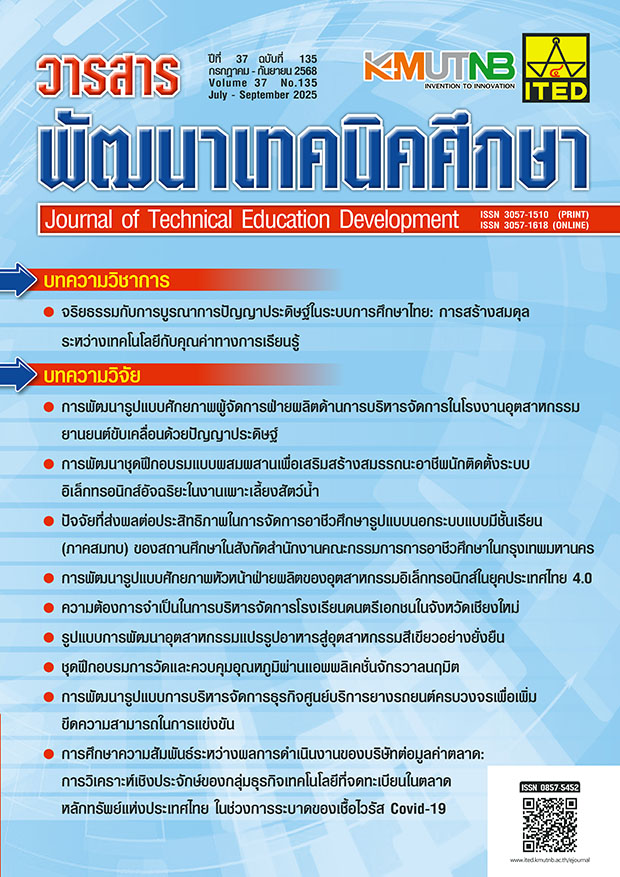
Development of a Blended Training Module for Enhancing Professional Competencies of Smart Electronics Installation Technicians in Aquaculture
Article Sidebar
Main Article Content
Abstract
The purpose of this research is : 1) to study the professional competency of smart electronics installation technicians in aquaculture for vocational education students; 2) to develop a blended training program to enhance the professional competency of smart electronics installation technicians in aquaculture; and 3) to investigate the learning outcomes of the developed blended training program. The research sample consisted of 30 higher vocational certificate students majoring in Electrical Power at the Nakhon Si Thammarat Seaboard Industrial College, Nakhon Si Thammarat. The research utilized a purposive sampling method. The research instruments included a competency assessment form, which utilized task analysis techniques to assess the suitability of the basic vocational competency training plan, a quality evaluation form for the blended training program to enhance professional competency, and a pre-test and post-test online assessment. Statistical methods, such as frequency distribution and percentage, mean and standard deviation, and paired samples t-test, were used for data analysis.
The research findings revealed that the professional competency of smart electronics installation technicians in aquaculture for vocational education students consisted of 2 main competency units and 7 sub competency units. The appropriateness of a professional competency training program, as evaluated by highly skilled experts, was compared to the quality of a blended training program designed to enhance professional competencies, also evaluated by highly skilled experts. Additionally, the effectiveness of the blended training program in improving the post-training academic performance of learners in the field of smart electronic system installation for aquaculture was assessed. The learners' post-training scores were significantly higher than their pre-training scores, with a statistical significance of .05
In summary, the developed blended training program proved effective in enhancing the vocational competencies of learners in the vocational education level through personalized learning approach, resulting in statistically significant improvement in post-training learning outcomes. The findings suggest that this training program can be used to equip future farmers with sufficient competencies to support the installation and maintenance of smart aquaculture farms.
Article Details

This work is licensed under a Creative Commons Attribution-NonCommercial-NoDerivatives 4.0 International License.
References
ประกาศเรื่องแผนพัฒนาเศรษฐกิจและสังคมแห่งชาติ ฉบับที่ 13 (พ.ศ.2566-2570). (2565). ราชกิจจานุเบกษา (เล่มที่ 139 ตอนพิเศษ 258 ง,1-143).
แผนปฏิบัติราชการ 5 ปี พ.ศ. 2566-2570. (2566). กรมประมง. https://www4.fisheries.go.th/local/pic_activities/202202171354041_pic.pdf
Dzulqornain, M. I., Harun Al Rasyid, M. U., & Sukaridhoto, S. (2018). Design and Development of Smart Aquaculture System Based on IFTTT Model and Cloud Integration [10.1051/matecconf/201816401030]. MATEC Web Conf., 164. https://doi.org/10.1051/matecconf/201816401030
Vo, T., Ko, H., Huh, J.-H., & Kim, Y. (2021). Overview of Smart Aquaculture System: Focusing on Applications of Machine Learning and Computer Vision. Electronics, 10, 2882. https://doi.org/10.3390/electronics10222882
กำธร สารวรรณ, สรายุทธ กรวิรัตน์, อุ้มบุญ เชลียงรัชต์ชัย, รณชัย สังหมื่นเม้า, เกษม เชตะวัน, และสาวิกา รัตนกร. (2563). การพัฒนาระบบสมาร์ทฟาร์มสำหรับการเพาะเลี้ยงสัตว์น้ำในบ่อ. วิศวกรรมสารฉบับวิจัยและพัฒนา, 31(4), 185-194.
ธิติศักดิ์ โพธิ์ทอง, ประสิทธิ์ เมฆอรุณ, และสิทธิชัย ชูสำโรง. (2019). การพัฒนาระบบฟาร์มอัจฉริยะสำหรับเกษตรกรยุคใหม่ด้วยซอร์ฟแวร์รหัสเปิด และอินเทอร์เน็ตของสรรพสิ่ง. วารสารเกษตรนเรศวร, 16(2),10-17. https://li01.tci-thaijo.org/index.php/aginujournal/article/view/247974
นิฏฐิตา เชิดชู, และวีระศักดิ์ ชื่นตา. (2019). การเพิ่มประสิทธิภาพการบริหารจัดการฟาร์มกุ้งด้วยการลดการใช้ไฟฟ้าที่ไม่ก่อให้เกิดประโยชน์และควบคุมการเลี้ยงด้วยเทคโนโลยีการเลี้ยงสัตว์น้ำแม่นยำ. วารสารเทคโนโลยีอุตสาหกรรม มหาวิทยาลัยราชภัฏอุบลราชธานี, 9(2), 85-96. https://ph01.tci-thaijo.org/index.php/jitubru/article/view/214936
ทวีศักดิ์ ธนเดโช, วิภพ ทีมสุวรรณ, และอุทัยวุฒิ ชำนาญแก้ว. (2561). ปฏิรูปเกษตรกรไทย. 11th THAICID NATIONAL SYMPOSIUM, โรงแรมริชมอนด์ จังหวัดนนทบุรี.
มนูญ บุญญะ, และกฤษมันต์ วัฒนาณรงค์. (2565). การพัฒนาชุดฝึกอบรมเพื่อเสริมสร้างสมรรถนะวิชาชีพช่างตู้เก็บเซรั่มแบบเย็นจัด. วารสารรัชต์ภาคย์, 16(44),280-294. https://so05.tci-thaijo.org/index.php/RJPJ/article/view/254944
วีระยุทธ สุดสมบูรณ์. (2559). การพัฒนาชุดฝึกอบรมโดยใช้มาตรฐานสมรรถนะอาชีพช่างวินิจฉัยข้อบกพร่องระบบควบคุมหัวฉีดอิเล็กทรอนิกส์ของเครื่องยนต์แก็สโซลีน. วารสารวิชาการเทคโนโลยีอุตสาหกรรม มหาวิทยาลัยราชภัฏนครศรีธรรมราช, 9(1),53-66.
สริวิชญ์ วิริยะชัย, และสรกฤช มณีวรรณี. (2563). การพัฒนากระบวนการฝึกอบรมแบบผสมผสานโซเชียลคลาวด์ผ่านการเล่าเรื่องดิจิทัลเพื่อส่งเสริมการคิดเชิงสร้างสรรค์และความร่วมมือทางการเรียนรู้สำหรับนักเรียนชั้นมัธยมศึกษาตอนปลาย. วารสารบัณฑิตวิทยาลัย มหาวิทยาลัยรามคำแหง ฉบับเทคโนโลยีการศึกษา, 4(1),31-47.
ธนาคาร คุ้มภัย, ประทิน เลี่ยนจำรูญ, และสมพร ปานดำ. (2564). การพัฒนากำลังคนอาชีวศึกษาด้านอุตสาหกรรมเพื่อรองรับการพัฒนาเศรษฐกิจฐานนวัตกรรม. วารสารนวัตกรรมการเรียนรู้และเทคโนโลยี, 1(1), 52-62.
สมพร ปานดำ. (2562). ยุทธศาสตร์การผลิตกำลังคนอาชีวศึกษาด้านเทคโนโลยีและนวัตกรรม ประเภทอุตสาหกรรมรองรับนโยบายการพัฒนาเศรษฐกิจฐานนวัตกรรม. วารสารพัฒนาเทคนิคศึกษา,
(116), 23-28.
ไชยยะ ธนพัฒน์ศิริ, บุษราคัม ทองเพชร, ปิยะ ประสงค์จันทร์, และวาสณา บุญส่ง. (2565). การประเมินความต้องการจำเป็นในการพัฒนาความรู้และทักษะทางด้านอิเล็กทรอนิกส์อัจฉริยะของแรงงานรองรับยุทธศาสตร์การพัฒนาพื้นที่ภาคใต้. วารสารพัฒนาเทคนิคศึกษา, 35(124), 42-52.
