
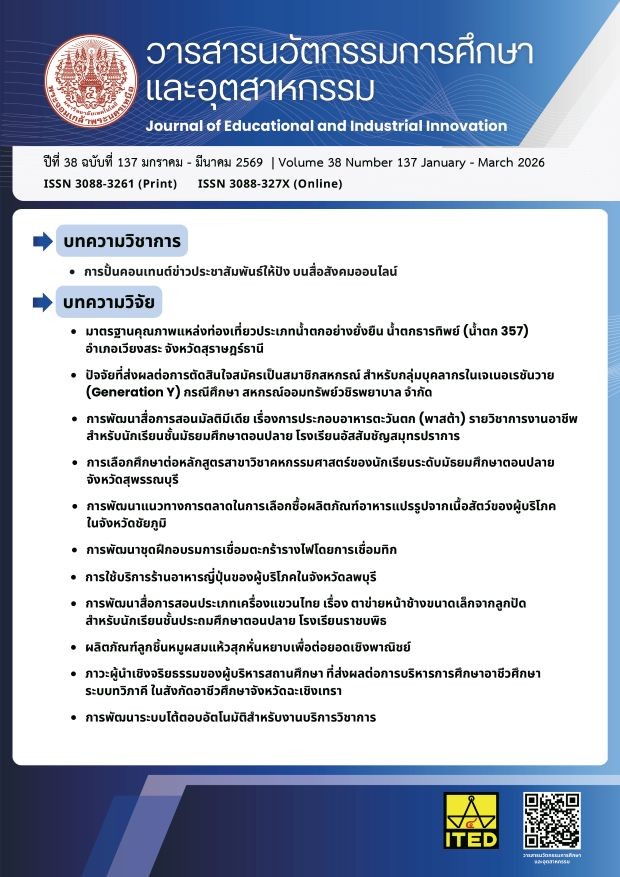
Decisions to Pursue a Home Economics Program Among Upper Secondary School Students in Suphan Buri Province
Article Sidebar
Main Article Content
Abstract
This research aims to explore three key aspects: 1) the intricate details of students’ personal backgrounds; 2) the nuanced decision-making processes guiding students to pursue further studies in a Home Economics program; and 3) a comprehensive comparison of factors influencing the decision to continue their academic journey within the Home Economics program, specifically in Suphan Buri Province. The categorization methodology was intricately aligned with the relevance to the personal backgrounds of upper secondary school students. The study included 316 students from Matthayom 6 who were enrolled during the academic year 2566 in Suphan Buri Province. The research methodology was robust, employing detailed statistical data recording, including frequency, percentages, mean, standard deviation, t-tests, and single-system analysis, to provide a thorough examination of data consistency.
The research brought forth insightful findings: 1) Matthayom 6 students aspiring to pursue further studies in the field of Home Economics in Suphan Buri Province were encouraged to articulate their preferences. Notably, females made up the majority, accounting for 64.24%, with 25.32% of all students opting for the Science-Mathematics curriculum. Additionally, most students had a cumulative GPA of 3.51 or higher, amounting to 47.46%. Moreover, 30.38% exhibited proficiency and interest in bakery; 95.89% resided in Suphan Buri Province; 23.73% accessed education information through Facebook and school guidance; and 29.43% had parents with a monthly income ranging from 15,001 to 25,000 Baht. Directly related to the choice of pursuing studies in Home Economics programs in Suphan Buri Province, Matthayom 6 students highly commended the 3) Regarding academic planning, students showcased significant divergence in decision-making based on cumulative GPA, personal interest and mastery, and channels for receiving education information. However, factors like gender, hometown, and average monthly income of parents exhibited no statistically significant impacts on the choice of Home Economics programs in Suphan Buri Province, as revealed by statistical tests at the .05 level.
Article Details

This work is licensed under a Creative Commons Attribution-NonCommercial-NoDerivatives 4.0 International License.
References
สำนักงานสภาพัฒนาการเศรษฐกิจและสังคมแห่งชาติ. (2565). แนวโน้มการเปลี่ยนแปลงระดับโลก. [สืบค้นเมื่อวันที่ 3 กรกฎาคม 2566]. จาก https://www.nesdc.go.th/main.php?filename=plan13/
สำนักงานคณะกรรมการการศึกษาขั้นพื้นฐาน. (2565). ข้อมูลทางการศึกษาขั้นพื้นฐาน. [สืบค้นเมื่อวันที่ 3 กรกฎาคม 2566]. จาก https://www.obec.go.th/
ฉัตรชัย อินทสังข์. (2562). ความต้องการและปัจจัยที่มีอิทธิพลต่อการตัดสินใจศึกษาระดับบัณฑิตศึกษาหลักสูตรบริหารธุรกิจบัณฑิต จังหวัดนครราชสีมา (รายงานการวิจัย). มหาวิทยาลัยเทคโนโลยีราชมงคลอีสาน.
ชัยพร จูผลดี. (2564). ปัจจัยที่มีผลต่อความต้องการเลือกเรียนระดับอุดมศึกษาของนักเรียนมัธยมศึกษาตอนปลาย : กรณีศึกษาในจังหวัดนนทบุรี (การค้นคว้าอิสระเศรษฐศาสตรมหาบัณฑิต). มหาวิทยาลัยหอการค้าไทย.
สุทัสสา อุปลกะลิน. (2564). การตัดสินใจเลือกสาขาในการศึกษาระดับอุดมศึกษาของนักเรียนมัธยมศึกษาปีที่ 6 : กรณีศึกษาโรงเรียนมหิดลวิทยานุสรณ์ จังหวัดนครปฐม (รายงานการวิจัย). สถาบันบัณฑิตพัฒนบริหารศาสตร์.
นิยาวาเฮร์ ไพบูลย์, และปฐมา อาแว. (2562). การตัดสินใจเลือกเข้าศึกษาต่อระดับปริญญาตรีของนักศึกษามหาวิทยาลัยสงขลานครินทร์ วิทยาเขตปัตตานี ปีการศึกษา 2562 (รายงานการวิจัย). มหาวิทยาลัยสงขลานครินทร์ วิทยาเขตปัตตานี.
เอกชัย เทียนเงิน. (2565). ปัจจัยที่ส่งผลต่อการตัดสินใจเลือกศึกษาระดับอุดมศึกษาของนักเรียนระดับมัธยมศึกษาตอนปลาย. วารสารศิลปศาสตร์ราชมงคลสุวรรณภูมิ, 4(3), 524–533.
วรวิทย์ รุ่งบุญพุฒิวงศ์. (2563). ปัจจัยในการเลือกศึกษาต่อหลักสูตรประกาศนียบัตรบัณฑิตวิชาชีพครูของมหาวิทยาลัยรามคำแหง (วิทยานิพนธ์ศึกษาศาสตรมหาบัณฑิต). มหาวิทยาลัยรามคำแหง.
พิชญาภา โสรัตน์, นพดล อำนวยพรเลิศ, และกนกวรรธน์ เซี่ยงเจ็น. (2565). ความคิดเห็นต่อปัจจัยที่มีผลต่อการตัดสินใจเลือกเข้าศึกษาต่อในระดับปริญญาตรี มหาวิทยาลัยพะเยา. วารสารศิลปศาสตร์ราชมงคลสุวรรณภูมิ, 4(3), 499–511.
อุปริฏฐา อินทรสาด และนัสมล บุตรวิเศษ. (2565). ความคิดเห็นของนักเรียนระดับชั้นมัธยมศึกษาตอนปลายที่มีต่อการจัดการสถานศึกษาของโรงเรียน สำนักงานเขตพื้นที่การศึกษามัธยมศึกษา จังหวัดพระนครศรีอยุธยา (รายงานการวิจัย). มหาวิทยาลัยเทคโนโลยีราชมงคลสุวรรณภูมิ.
ปุณิกา แจ่มจำรัส. (2561). ความคาดหวังของผู้สอนและผู้เรียนที่มีต่อศักยภาพการบริหารงานวิชาการของโรงเรียนศรีวัฒนาบริหารธุรกิจและเทคโนโลยีนานาชาติ (วิทยานิพนธ์บริหารธุรกิจมหาบัณฑิต). มหาวิทยาลัยธนบุรี.
