
Development Of A Self-learning Intelligent Machine For The Geographic Information System (GIS) To Classify And Diagnose Sugarcane Production From Satellite Images
Article Sidebar
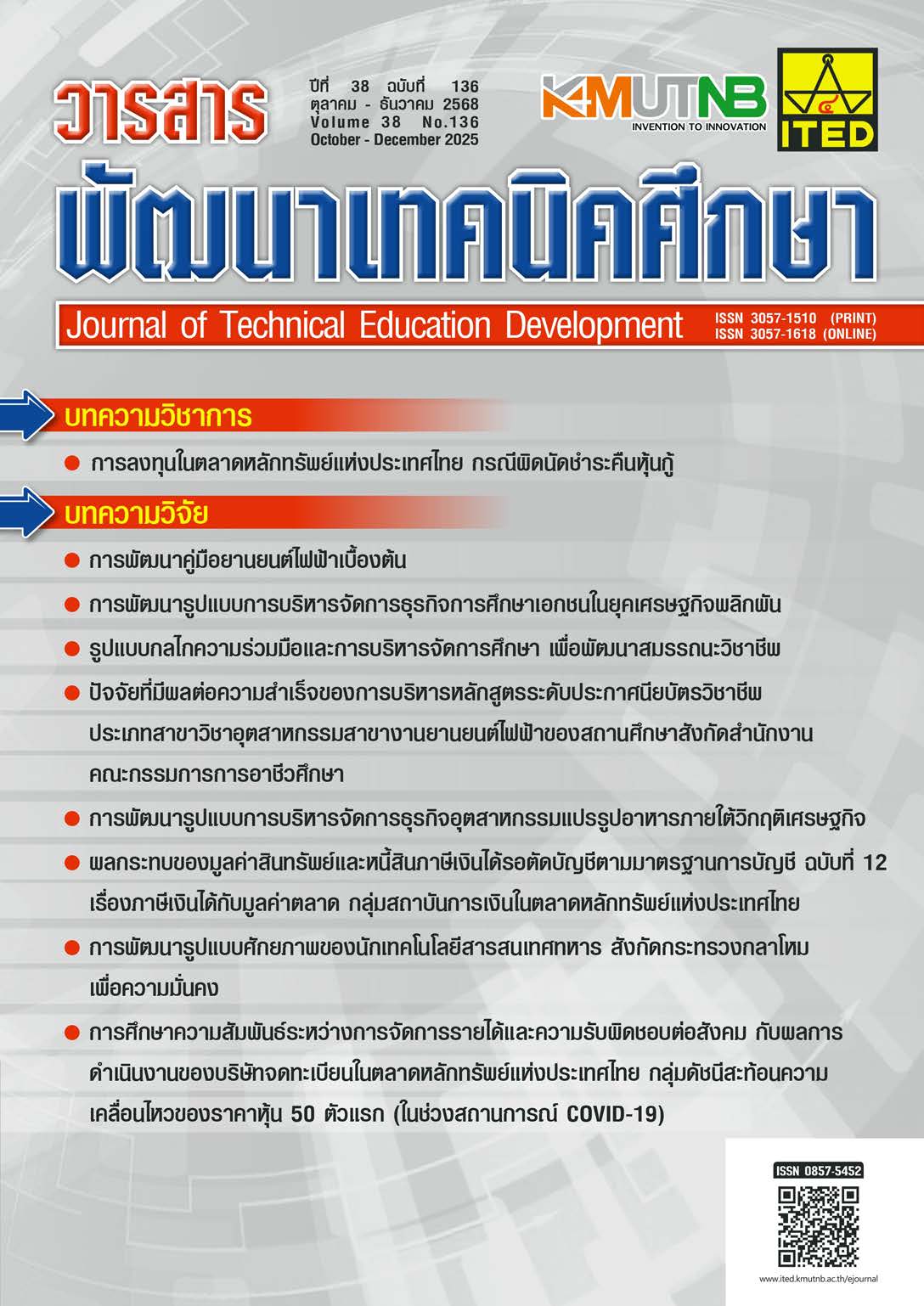
Main Article Content
Abstract
Sugarcane is an essential economic cultivation of Thailand, obtaining a GDP of approximately 200,000 million Baths annually. However, the sugarcane industry has many crises, especially sugarcane yield and production fluctuations. This project aims to develop a self-learning intelligence kit for a geographic information system to 1) classify the sugarcane area and 2) forecast sugarcane's yield. The location is in Sa Kaew Province. In the classification, Landsat 9 image and Sentinel-1A are acquired and associated with three AI algorithms i.e. artificial neural network, random forest, and gradient boosting. In yield forecasting, four vegetation indices extracting from Landsat 8 imagery are incorporated with five AI regressor algorithms i.e. multiple-linear regressor, multi-layer perceptron, decision tree regressor, random forest regressor, and gaussian process regressor.
Classification result reveals that the random forest provides the highest efficiency, attaining an accuracy of 0.76. The prediction of the sugarcane class reaches 0.89. Yield forecasting result reveals that the random forest regressor also provides the highest efficiency, achieving a coefficient of determination of 0.79. The mean average error reveals 0.79 ton/rai. In the application of AI, input data and hyperparameter testing should be considered for the highest efficiency of models.
Article Details

This work is licensed under a Creative Commons Attribution-NonCommercial-NoDerivatives 4.0 International License.
References
Ennouri, Karim & Kallel, Abdelaziz. (2019). Remote Sensing: An Advanced Technique for Crop Condition Assessment. Mathematical Problems in Engineering. 2019. 1-8. 10.1155/2019/9404565.
FAO. (2017). [ออนไลน์]. The future of food and agriculture: trends and challenges. [Retrieved August 3, 2022]. from https://www.fao.org/3/i6583e/i6583e.pdf.
Luciano, A. C. d. S., Campagnuci, B. C. G., & le Maire, G. (2022). Mapping 33 years of sugarcane evolution in São Paulo state, Brazil, using landsat imagery and generalized space-time classifiers. Remote Sensing Applications: Society and Environment.26.100749. doi:https://doi.org/10.1016/j.rsase.2022.10074
Luciano, A. C. d. S., Picoli, M. C. A., Rocha, J. V., Duft, D. G., Lamparelli, R. A. C., Leal, M. R. L. V., & Le Maire, G. (2019). A generalized space-time OBIA classification scheme to map sugarcane areas at regional scale, using Landsat images time-series and the random forest algorithm. International Journal of Applied Earth Observation and Geoinformation.80. 127-136. doi: 10.1016/j.jag.2019.04.013
Singh, R., Patel, N. R., & Danodia, A. (2020). Mapping of sugarcane crop types from multi-date IRS-Resourcesat satellite data by various classification methods and field-level GPS survey. Remote Sensing Applications: Society and Environment. 19. 100340. doi:10.1016/j.rsase.2020.10034
Akbarian, S., Xu, C., Wang, W., Ginns, S., & Lim, S. (2022). An investigation on the best-fit models for sugarcane biomass estimation by linear mixed-effect modelling on unmanned aerial vehicle-based multispectral images: A case study of Australia. Information Processing in Agriculture.
Nihar, A., Patel, N. R., Pokhariyal, S., & Danodia, A.. (2022). Sugarcane Crop Type Discrimination and Area Mapping at Field Scale Using Sentinel I mages and Machine Learning Methods. Journal of the Indian Society of Remote Sensing. 50(2). 217-225. doi:10.1007/s12524-021-01444-0
Singla, S. K., Garg, R. D., & Dubey, O. P.. (2021). Ensemble machine learning methods for spatiooral data analysis of plant and ratoon sugarcane. Intelligent Data Analysis. 25(5). 1291-1322. doi:10.3233/IDA-205302
Dimov, D., Uhl, J. H., Löw, F., & Seboka, G. N. (2022). Sugarcane yield estimation through remote sensing time series and phenology metrics. Smart Agricultural Technology. 2. 100046.
Intarat, K., & Sillaparat, S. (2019). Tropical Mangrove Species Classification Using Random Forest Algorithm and Very High-Resolution Satellite Imagery. Burapha Science Journal. 24(2). 742-753.
Som-Ard, J., Atzberger, C., Izquierdo-Verdiguier, E., Vuolo, F., & Immitzer, M. (2021). Remote sensing applications in sugarcane cultivation: A review. Remote Sensing. 13(20). doi:10.3390/rs13204040
Bhosle, K., & Musande, V. (2019). Evaluation of deep learning convolutional neural network for crop classification. International Journal of Recent Technology and Engineering. 8(2). 3960-3963. doi:10.35940/ijrte.B2872.078219
Cobeña Cevallos, J. P., Atiencia Villagomez, J. M., & Andryshchenko, I. S. (2019). Convolutional neural network in the recognition of spatial images of sugarcane crops in the troncal region of the coast of Ecuador.
Poortinga, A., Thwal, N. S., Khanal, N., Mayer, T., Bhandari, B., Markert, K., . Saah, D. (2021). Mapping sugarcane in Thailand using transfer learning, a lightweight convolutional neural network, NICFI high resolution satellite imagery and Google Earth Engine. ISPRS Open Journal of Photogrammetry and Remote Sensing. 1. 100003.
Virnodkar, S., Pachghare, V. K., & Murade, S. (2021) A Technique to Classify Sugarcane Crop from Sentinel-2 Satellite Imagery Using U-Net Architecture. Springer Science and Business Media Deutschland GmbH. 1199. 322-330.
Reungsang, P. & Butkhot, T. (2021) Assessment of machine learning on sugarcane classification using Landsat-8and Sentinel-2satellite imagery. Asia-Pacific Journal of Science and Technology. 26(4). 1-11.
Dela Torre, D. M. G., & Perez, G. J. P. (2014). Phenology-based classification of major crops areas in Central Luzon, Philippines from 2001-2013.
Jiang, H., Li, D., Jing, W., Xu, J., Huang, J., Yang, J., & Chen, S. (2019). Early Season Mapping of Sugarcane by Applying Machine Learning Algorithms to Sentinel-1A/2 Time Series Data: A Case Study in Zhanjiang City. China. Remote Sensing. 11. 861. doi: 10.3390/rs11070861.
Maxwell, Aaron & Warner, Timothy & Fang, Fang. (2018). Implementation of machine-learning classification in remote sensing: An applied review. International Journal of Remote Sensing. 39. 9. 39. 2784-2817. doi:10.1080/01431161.2018.1433343.
