
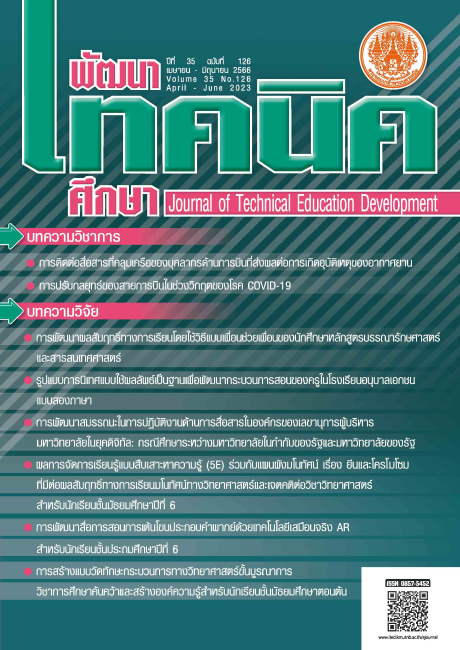
Development of Organizational Communication Competence of University Executive Secretaries in the Digital Age : A Case Study of between the Autonomous University and State University
Article Sidebar
Main Article Content
Abstract
The study main objectives are 1) to explore the problems and challenges of organizational communication issues faced by university administrators’ executive secretaries in the digital age. Duties and responsibilities performed by executive secretaries of autonomous or of state universities in the present circumstances were investigated; 2) to compare the two groups in respect of a demand to improve organizational communication skills; and 3) to suggest some guidelines and recommendations for more effective communication skills among these staff personnel. Using purposive sampling, the researcher collected the data from 303 individuals serving as executive secretaries in an autonomous or in a state university. The study used purposive sampling for informant selection. Interviews and questionnaires are tools used to collect data. The statistics for data analysis included percentage, mean, frequency, standard deviation, t- and F-tests. The results showed that :
- Both types of sample groups, i.e. executive secretaries of autonomous and of state universities revealed a high level of demand to develop their knowledge competencies for performing duties (M= 4.40). The requirement subcomponents were telephone etiquette; social media savvy skills, e.g. Line and Facebook mastery; and effective time-management to help them achieve their goals (M=4.55, 4.52, and 4.48 respectively). The needs to improve comprehensive skill development were at a high level (M=4.32). The subcomponents disclosed a demand for developing effective communication and teamwork skills; social media savviness; and emotional intelligence for coping with stress at work, (M= 4.47, 4.42 and 4.40 respectively). The needs for improvement of secretarial desirable skills were at the highest level (M=4.55). When considering the top 3 aspects, the personnel performing duties as executive secretaries showed the need to develop desirable attributes in a prioritized order as follows: integrity at work and loyalty to supervisor; maintaining confidentiality for supervisors; as well as accountability and punctuality (M=4.66, 4.64 and 4.61 respectively), all of which falls within the highest level of measurement.
2. Statistically significant differences were observed between executive secretaries of both autonomous and state universities with regard to their need levels to enhance professional skills, organizational communication, knowledge and competencies (p<.05). However, no significant difference was observed between the two groups regarding desirable characteristics.
Article Details

This work is licensed under a Creative Commons Attribution-NonCommercial-NoDerivatives 4.0 International License.
References
เอกสารอ้างอิง
เกษกานดา สุภาพจน์. (ม.ป.พ.). วิชาเทคนิคการเป็นเลขานุการ. เอกสารประกอบการสอน มหาวิทยาลัยเทคโนโลยีราชมงคล, [ม.ป.พ.]. (บทที่ 1)
McClelland, D.C. (1973). “Testing for Competence Rather Than for Intelligence.” American Psychologists. Vol.17 : 1-14.
Likert, R. (1932). A Technique for the Measurement of Attitudes. Arch. Psychol, 22, 5–54.
สำนักงานคณะกรรมการข้าราชการพลเรือน. (2563). “กำลังคน (ภาครัฐ) ในศัตวรรษที่ 21.” วารสารข้าราชการ. ปีที่ 62 ฉบับที่ 2.
สำนักงานคณะกรรมการข้าราชการพลเรือน. (2553). คู่มือการกำหนดความรู้ความสามารถ ทักษะ และสมรรถนะสำหรับตำแหน่ง. กรุงเทพมหานคร: บริษัท ประชุมช่าง จำกัด.
สำนักงานคณะกรรมการข้าราชการพลเรือน. (2560). แนวทางการพัฒนาทักษะด้านดิจิทัลของข้าราชการและบุคลากรภาครัฐ. [ออนไลน์]. [สืบค้นเมื่อ วันที่ 18 สิงหาคม 2565]. จาก https://www.ocsc.go.th/sites/default/files/attachment/page/process_dev_digital.pdf
เกรียงศักดิ์ เจริญวงศ์ศักดิ์. (2560). [ออนไลน์]. องค์กรแห่งยุคเศรษฐกิจดิจิทัล. [สืบค้นเมื่อ วันที่ 21 พฤษภาคม 2564]. จาก http://drdancando.com/
ปิยฉัตร จันทิวา สุชาติ เซี่ยงฉิน ธีรวุฒิ บุณยโสภณ และวิเชียร เกตุสิงห์. (2560). “รูปแบบการพัฒนาขีดความสามารถในการปฏิบัติงานของเลขานุการผู้บริหารในสถานประกอบการ”. วารสารวิชาการพระจอมเกล้าพระนครเหนือ. ปีที่ 27 ฉบับที่ 3 กรกฎาคม – กันยายน.
นภัสวรรณ เกียรติวุฒิกาญจน์ และสำเริง อ่อนสัมพันธ์. (2554). “สมรรถนะที่ประสงค์ของเลขานุการผู้บริหารระดับสูง มหาวิทยาลัยมหิดล วิทยาเขตกาญจนบุรี”. วารสารการบริหารการศึกษา มหาวิทยาลัยศิลปากร. ปีที่ 2 ฉบับที่ 1 (กรกฎาคม - ธันวาคม).
ณัฐสุรีย์ หวังสถิตย์วงษ์. (2560). "การศึกษาเปรียบเทียบสมรรถนะที่พึงประสงค์ในการปฏิบัติงานของเลขานุการผู้บริหารมหาวิทยาลัยในกำกับของรัฐกับมหาวิทยาลัยของรัฐ." วารสารวิชาการศิลปศาสตร์ประยุกต์. กรกฎาคม - ธันวาคม.
ณชิตา หิรัญพิชา. (2561). ทัศนะของผู้บริหารที่มีต่อสมรรถนะของผู้ปฏิบัติงานเลขานุการในมหาวิทยาลัยเทคโนโลยีราชมงคลธัญบุรี. มหาวิทยาลัยเทคโนโลยีราชมงคลธัญบุรี.
