
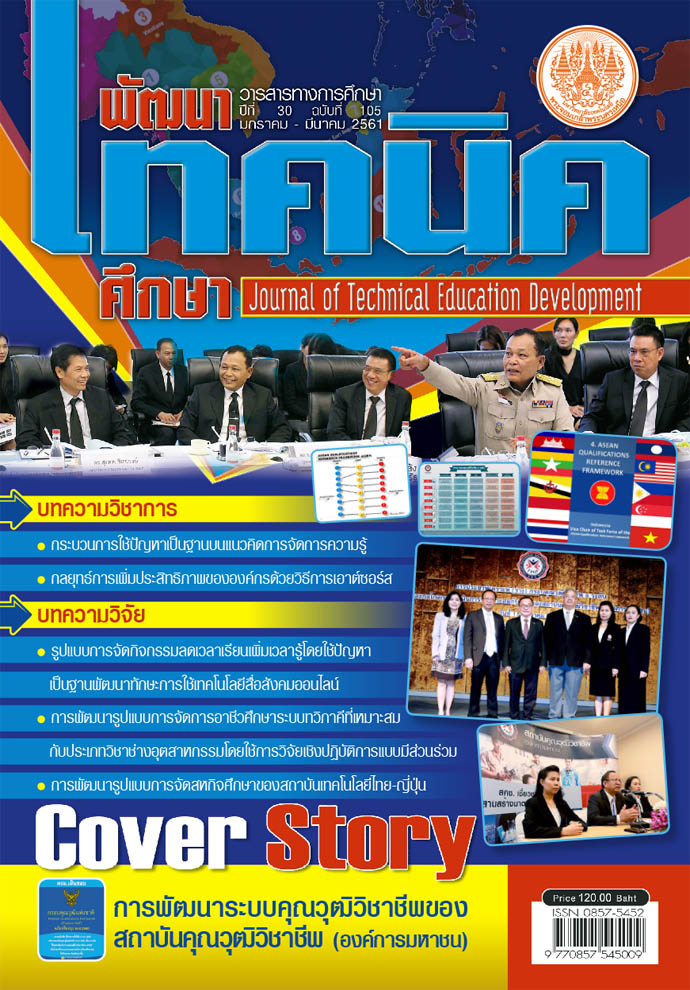
The Development of Dual Vocational Education System Model for Suitable Industrial Trade Using Participatory Action Research
Article Sidebar
Main Article Content
Abstract
The objective of this research were to develop model of Dual Vocation Education System, and to tryout and assessment the model of Dual Vocation Education System by using the participatory action research method. The study documents and related research The recommendations of the expert, Educational and developmental needs of teaching bilateral system. The samplegroup included administrator, company administrator, trainer in the workplace and head office of dual vocation education system of 1,005 people. The number of 201 school, Using multi-stage random sampling, The instruments a questionnaire Manual focus groups and then analyze the data to develop a model. The results revealed that the dual vocation Education model included There are 5 factors of dual vocation education system included personal, curriculum, measurement and evaluation, teaching, workplace cooperation. And The result of Construct Validity in dual vocation education system model by confirmatory factor analysis were Goodness of fit test, And The standards evaluation of utility, feasibility, propriety and accuracy were at a very high level.
Article Details

This work is licensed under a Creative Commons Attribution-NonCommercial-NoDerivatives 4.0 International License.
References
ปาริฉัตร จันโทริ. (2555). การศึกษาระบบทวิภาคีทางออกของปัญหาแรงงานไทย.วารสารบริหารธุรกิจ ปีที่ 35 ฉบับที่ 135 กรกฎาคม - กันยายน 2555. 29-30.
กระทรวงศึกษาธิการ. (2546). พระราชบัญญัติ การศึกษาแห่งชาติ พ.ศ. 2542 และแก้ไข เพิ่มเติม(ฉบับที่ 2) พ.ศ.2545 พร้อมกฎกระทรวงที่เกี่ยวข้องของพระราชบัญญัติการศึกษาภาคบังคับ พ.ศ. 2545. กรุงเทพมหานคร:โรงพิมพ์องค์การรับส่งสินค้าและพัสดุภัณฑ์(ร.ส.พ.)
. พระราชบัญญัติการอาชีวศึกษา พ.ศ. 2551,ราชกิจจานุเบกษา. เล่ม125 ตอนที 6 43 ก.หน้า 3.
ชนะ กสิภาร์. (2523). แนวทางในการจัดการเรียนการสอนช่างอุตสาหกรรม. กรุงเทพมหานคร: สถาบันเทคโนโลยีพระจอมเกล้าพระนครเหนือ.
จำปี อู่เงิน. (2541). ปัญหาการเรียนการสอนและผลสัมฤทธิ์ทางการเรียนของนักเรียนระบบทวิภาคีในวิทยาลัยเทคนิคภาคเหนือ ตามหลักสูตรปวช. 2538. แพร่ : วิทยาลัยเทคนิคแพร่.
. Kemmis, S., & McTaggart, R. (2000).Participatory action research. In N.Denzin and Y. Lincoln (Eds.), The Handbook of Qualitative Research
(2nd ed.). London: Sage.
พงศ์เทพ จิระโร. (2546). การพัฒนาระบบประกันคุณภาพภายในสำหรับการศึกษา เฉพาะทางของกองทัพเรือ. วิทยานิพนธ์ ค.ด. การวัดและประเมินผลการศึกษา. คณะครุ
ศาสตร์จุฬาลงกรณ์มหาวิทยาลัย.
Stufflebeam, D., & Shinkfield, A. (2007). Evaluation theory, models, and applications. San Francisco: Jossey-
Bass.
อนันต์ งามสะอาด. (2549). การจัดการอาชีวศึกษาระบบทวิภาคีด้วยหลักการมีส่วน ร่วม: กรณีวิทยาลัยเทคนิคเดชอุดม. วิทยานิพนธ์ ค.ด. การบริหารการศึกษา.
บัณฑิตวิทยาลัย มหาวิทยาลัยขอนแก่น.
