
Analysis of Buddhist mural painting in Chiang Mai Province
Article Sidebar
Main Article Content
Abstract
Buddhist painting in Buddhism depicts the history of Buddhism and the way of life of the local people, related to beliefs, customs, and art and culture. This research article aims: 1) to study the historical background, Buddhist beliefs, and characteristics of mural paintings in Chiang Mai Province; and 2) to analyze the styles, techniques, artistic elements, and artistic values of mural paintings in Chiang Mai Province.
The research methodology adopts qualitative research employing documentary research in conjunction with survey-based field research to systematically examine data relevant to the research issues. Data were collected from a wide range of scholarly sources, including
academic documents, related research, books, and other materials, included by field surveys within the designated research sites focusing on 5 temples namely : (1) Wat Umong, (2) Wat Phra Singh, (3) Wat Prasat, (4) Wat Buak Krok Luang, and (5) Wat Tha Kham. These sites served as
primary sources of qualitative data, which were subsequently analyzed and synthesized in fulfilling the established research objectives.
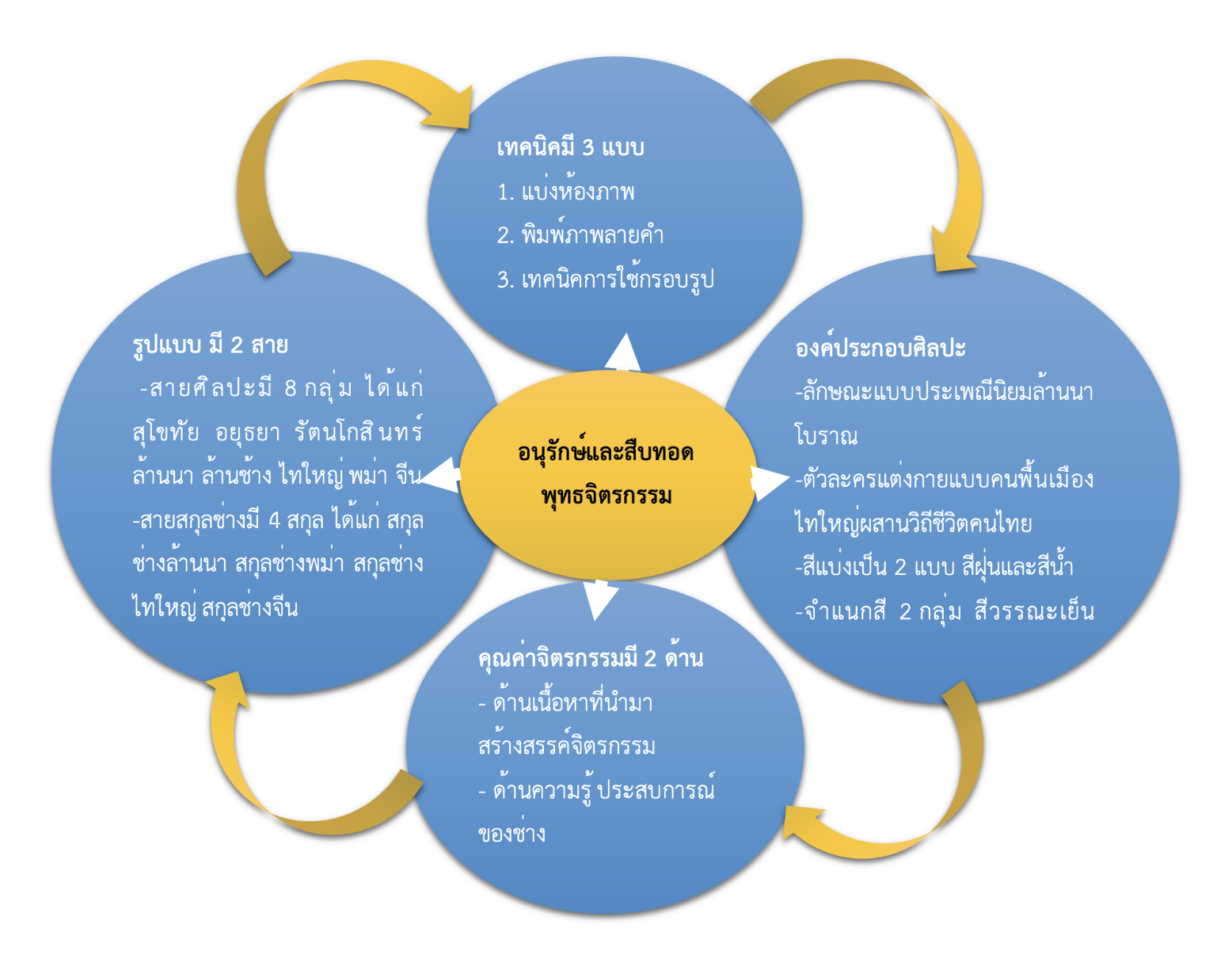
The findings reveal that: 1) Buddhism is the primary institution that promotes knowledge among citizens, with temples and monks serving as the center of society. Beliefs and doctrines are reflected through mural paintings in temples, which serve two main functions: (1) decoration and (2) instruction for worshippers. This is achieved through painted murals and printed lacquered designs (lai kham). The themes depicted in the murals include the life of the Buddha, the history of temples, ways of life, folktales, Jataka tales, the Sutta Pitaka, Buddhist teachings, beliefs, traditions, culture, and children’s games. 2) The forms can be classified into two main lineages. The first is the artistic lineage, which comprises 8 groups: Sukhothai, Ayutthaya, Rattanakosin, Lanna, Lan Chang, Tai Yai (Shan), Burmese, and Chinese. The second is the craft lineage, which consists of 4 schools: the local Thai artisan school, the Lanna artisan school, the Tai Yai (Shan) artisan school, and the Chinese artisan school. In terms of techniques, there are three types: the division of pictorial panels, the printing of lai kham patterns, and the use of frames. The values of mural paintings
include the preservation of art from all eight groups, the use of techniques and artistic elements as sources of study, the use of narrative content for instruction, and the conservation and transmission of cultural heritage.
Article Details
References
เชษฐ์ ติงสัญชลี, (2555). สัตตมหาสถาน พุทธประวัติตอนเสวยวิมุตติสุขกับศิลปกรรมอินเดียและเอเชียอาคเนย์. พิมพ์ครั้งที่ 1. กรุงเทพมหานคร: สำนักพิมพ์เมืองโบราณ.
แทมมาริน วิลเลจ, (2560). ย้อนรอยอารยะ ประเพณี วัฒนธรรม และความเชื่อ. เชียงใหม่: นพบุรีการพิมพ์
ธนกฤต ก้องเวหา. (2568). ไข่แม่กาเผือกมารดาของพระพุทธเจ้าทั้ง 5 องค์. [ออนไลน์]. จาก : https://www.silpamag.com.
พระราชนิพนธ์โดยพระบาทสมเด็จพระพุทธเลิศหล้านภาลัย รัชกาลที่ 2. (2530). เรื่องสุวรรณหงส์. ฉบับที่ 2. กรมศิลปากร. กรุงเทพมหานคร: โรงพิมพ์ไพศาลศิริ ท่าพระจันทร์.
พิสิฏฐ์ โคตรสุโพธิ์, ธเนศ ศรีวิชัยลำพันธ์, วีระพงษ์ แสง-ชูโต, (2557). การถ่ายทอดศิลปะและวัฒนธรรมภูมปัญญาล้านนาสู่สังคมโดยผู้ทรงภูมิปัญญาท้องถิ่น. เชียงใหม่: นพบุรีการพิมพ์เชียงใหม่.
ภัคจิรา องค์ศิริพร, (2564). ศึกษาเรื่องจิตรกรรมฝาผนังล้านนาสู่จิตรกรรมร่วมสมัยสะท้อนวิถีชีวิตไทย. รายงานวิจัย. บัณฑิตวิทยาลัย หาวิทยาลัยเทคโนโลยีราชมงคลธัญบุรี.
มหาจุฬาลงกรณราชวิทยาลัย. (2535). พระไตรปิฎกภาษาบาลี ฉบับมหาจุฬาเตปิฏกํ 2500. กรุงเทพมหานคร: โรงพิมพ์มหาจุฬาลงกรณราชวิทยาลัย.
รื่นฤทัย สัจจพันธุ์. (2561). สังข์ทอ. กรุงเทพมหานคร: แสงดาวการพิมพ์.
ศักดิ์ชัย เกียรตินาคินทร์. (2542). ความสัมพันธ์ระหว่างคุณค่าศิลปกรรมกับการสร้างทัศนคติต่อตนเองและความผูกพันกับชุมชน. ดุษฎีนิพนธ์คุรุศาสตร์ดุษฎีบัณฑิต. จุฬาลงกรณมหาวิทยาลัย.
สุชัย สิริรวีกูล, พระครูพิพิธสุดาทร,พูนชัย ปันธิยะ. (2562). วิเคราะห์พุทธศิลป์ล้านนากับกระบวนการสร้างความสัมพันธ์กลุ่มชาติพันธุ์อนุภูมิภาคลุ่มแม่น้ำ. วารสารมหาจุฬานาครทรรศน์. 6(5), 2356. Link : https://so03.tci-thaijo.org/index.php/JMND/article/view/192372/143393
