
Analysis of stucco decorations on the stupa of Wat Pa Sak, Chiang Saen, Wat Suwannasiriphothikham and Wat Thongthip Phatthanaram, Ton Pheung, Laos
Article Sidebar
Main Article Content
Abstract
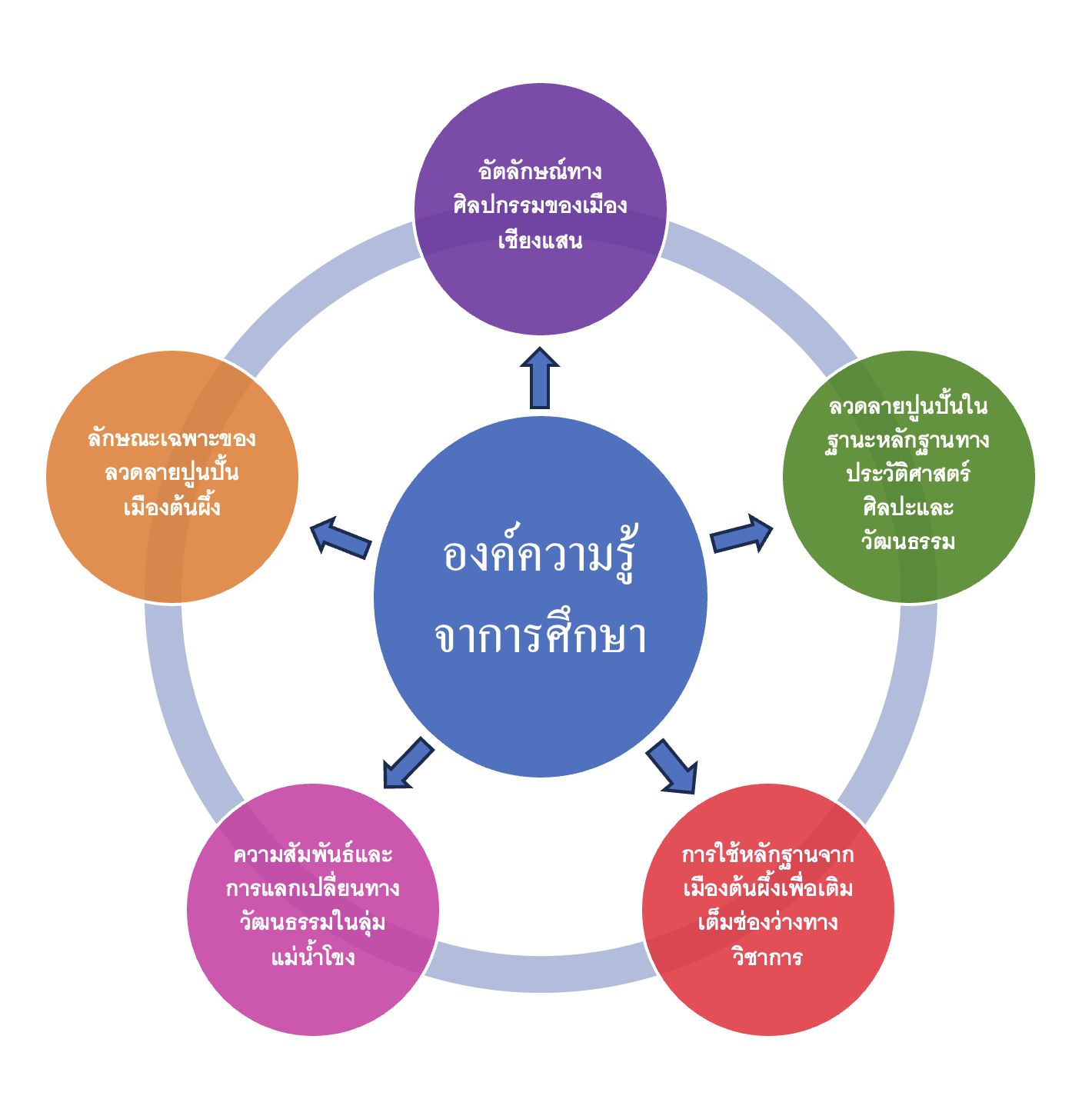
This study aims to conduct a comparative analysis of stucco motifs found in Chiang Saen, Chiang Rai Province, Thailand, and Ton Pheung, Bokeo Province, Lao People’s Democratic Republic, to highlight their artistic identity, style, construction techniques, and cultural relationships. The study employs art historical and archaeological methodologies, utilizing field surveys, pattern analysis, and historical document analysis. The main study areas include the Wat Pa Sak stupa in Chiang Saen and stucco evidence unearthed from excavations in the Mekong River, preserved at Wat Thongthip Phatthanaram and Wat Suwannasiri Phothikham in Ton Pheung. Laos.
The results show that the stucco motifs in Chiang Saen are characterized by their thickness, volume, and complexity, reflecting early Lanna art influenced by Hariphunchai, Bagan, Sukhothai, Khmer, and Sri Lankan art. In contrast, the stucco motifs in Ton Pheung are more airy, slender, emphasizing symmetry and order, consistent with 21st-century Lanna art. A comparison of various pattern types, including kanok patterns, floral patterns, leaf patterns, and vine-like kanok patterns, reveals both differences in sculpting techniques and similarities in style. This reflects the cultural exchange and transmission between communities on both sides of the Mekong River.
This study indicates that Chiang Saen and Ton Phueng had a close historical and cultural relationship in the past, even before the demarcation of nation-states during the colonial era. The stucco patterns serve as important artistic evidence in explaining the social, religious, and cultural dynamics of the Mekong River basin. The results can be used as a database for comparative studies of art in the region, as well as for planning the sustainable conservation and restoration of stucco art heritage.
Article Details
References
นุชนภางค์ ชุมดี. (2549). การตั้งถิ่นฐานและพัฒนาการของชุมชนโบราณในเขตเมืองเชียงแสนระหว่างพุทธศตวรรษที่ 19–24. วิทยานิพนธ์ศิลปศาสตรมหาบัณฑิต สาขาวิชาประวัติศาสตร์. บัณฑิตวิทยาลัย มหาวิทยาลัยเชียงใหม่.
ปริวรรต ธรรมาปรีชากร. (2545). ตามรอย พระเจ้าล้านตื้อ พระพุทธรูปแห่งลำน้ำโขง. [ออนไลน์]. https://www.silpa-mag.com/history/article_93359
พระรัตนปัญญาเถระ. (2517). ชินกาลมาลีปกรณ์. แปลโดย แสง มนวิทูร. กรุงเทพมหานคร: ม.ป.พ.
ม.ล.สุรสวัสดิ์ สุขสวัสดิ์. (2545). เที่ยววัดเที่ยววา ชมปูนปั้นล้านนา. กรุงเทพมหานคร: สายธาร.
ศิริศักดิ์ อภิศักดิ์มนตรี. (2556). เมืองประวัติศาสตร์เชียงแสน. เชียงใหม่: สำนักศิลปากรที่ 8 เชียงใหม่.
สันติ เล็กสุขุม. (2538). ศิลปะภาคเหนือ หริภุญชัย-ล้านนา. กรุงเทพมหานคร : เมืองโบราณ.
สุรพล ดำริห์กุล. (2545). แผ่นดินล้านนา. กรุงเทพมหานคร: เมืองโบราณ.
สุรพล ดำริห์กุล. (2561). ประวัติศาสตร์และศิลปะล้านนา. นนทบุรี: เมืองโบราณ.
องค์การค้าของคุรุสภา. (2512). ประชุมพงศาวดาร ภาคที่ 61 พงศาวดารเมืองเงินยางเชียงแสน.กรุงเทพมหานคร: ศึกษาภัณฑ์พาณิชย์.
องค์การค้าของคุรุสภา. (2512). ประชุมพงศาวดาร ภาคที่ 61 พงศาวดารเมืองเงินยางเชียงแสน.กรุงเทพมหานคร: ศึกษาภัณฑ์พาณิชย์.
