
The Sculpture of Nang See Wei from the Muralpainting of Tamon Temple, Long District, Phrae
Article Sidebar
Main Article Content
Abstract
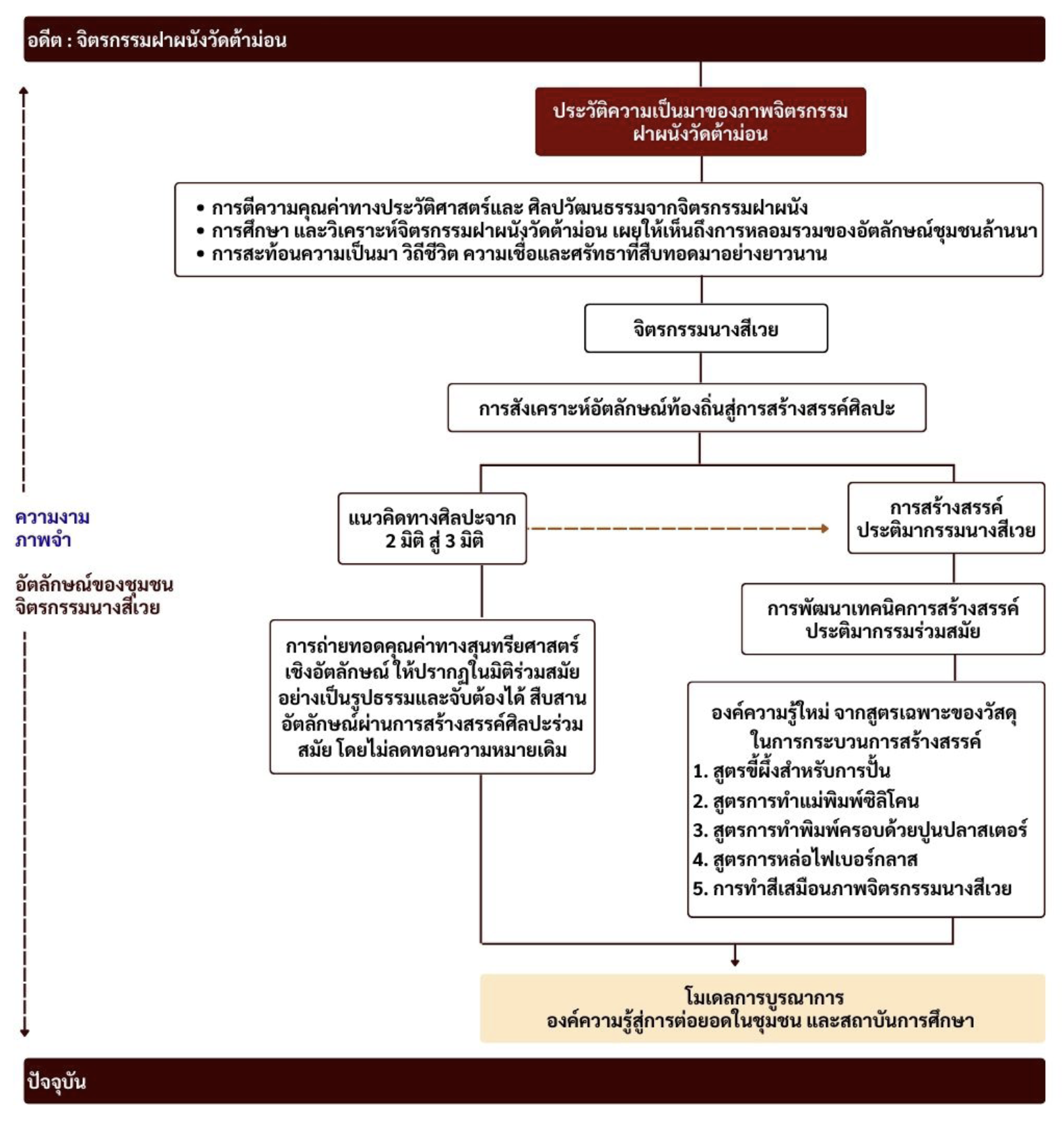
This creative research study had two main objectives 1) to collect and publish the history of the mural paintings at Tamon Temple, and 2) to create a sculpture of Nang See Wei, inspired by the mural of Nang See Wei, to highlight the distinctive beauty and cultural identity of the Tamon community.
The research methodology combined creative art research with a quantitative
approach. The study population and sample consisted of 171 individuals, divided into two groups (1) a sample of 118 people used to survey the community’s needs and suggestions for creating the Nang See Wei sculpture prototype and (2) a sample of 53 people who evaluated the satisfaction with the sculpture prototype.
The study’s findings were as follows 1) the collection and dissemination of the history of Tamon Temple murals broadened public understanding and conveyed the knowledge, values, and historical significance of the paintings, which serve as cultural symbols connecting the
community’s way of life and beliefs to a wider audience and 2) The researcher successfully
created a three dimensional sculpture of Nang See Wei, inspired by the two dimensional mural, translating the essence of the two dimensional artwork into a contemporary three dimensional form. This piece conveys the community’s identity and aesthetic value in a new dimension.
The satisfaction evaluation of the Nang See Wei sculpture prototype showed a very high level of satisfaction, with an average score of (x̄ = 4.81, S.D. = 0.42). The participants specifically
appreciated that the sculpture’s color resembled the original mural and that its composition was beautiful. This creative work highlights the importance of contemporary art as a medium to connect people with their local history, wisdom, and identity in a harmonious way. Additionally, the process of experimentation and refinement led to new technical knowledge, creating a learning innovation that can be applied to other art forms. This work also fosters a sense of pride and builds a collaborative network for the preservation and continuation of cultural heritage.
Article Details
References
โอม พัฒนโชติ. (2563). การพัฒนาประติมากรรมร่วมสมัย โดยบูรณาการร่วมระหว่างศิลปะจัดวางดิจิทัลอาร์ต และเทคโนโลยีพลังงานแสงอาทิตย์ เพื่อสร้างอัตลักษณ์ภูมิทัศน์ของ
ชุมชน. วารสารมนุษยสังคมปริทัศน์. 22(2), 89. https://so05.tci-thaijo.org/index.php/hspbruacthjournal/article/view /252892/171319
พระครูใบฎีกาวิชาญ วิสุทโธ และภักดี โพธิ์สิงห์. (2563). อัตลักษณ์ท้องถิ่นสู่การจัดการท่องเที่ยวเชิงสร้างสรรค์. วารสารวนัมฎองแหรกพุทธศาสตรปริทรรศน์. 9(2), 139. https://so06.tci-thaijo.org/index.php/Vanam_434/article/view/259429/175425
ภูเดช แสนสา. ( 2564). รูปแต้มวัดต้าม่อน เมืองต้า วัดพม่าปลายแดนด้านทิศตะวันออกเมืองนครลำปาง. วารสารข่วงผญา มหาวิทยาลัยราชภัฏเชียงใหม่. 15(1), 54, 57, 67-68. https://so06.tci-thaijo.org/index.php/ khuangpaya/article/view/247883/168592
ศุภรัตน์ อินทนิเวศ. (2562). การศึกษาจิตรกรรมฝาผนังวัดอารามหลวงในพื้นที่ภาคเหนือตอนบน. วารสารสังคมศาสตร์วิชาการ. 12(3), 381. https://so04.tci-thaijo.org/index.php/social_crru/article/view/ 232000/158350
ศุภรา อรุณศรีมรกต. (2561). การรับรู้ผ่านทัศนธาตุ: มุมมองใหม่จากงานออกแบบสู่งานศิลปะ. วารสารเวอริเดียน อี- เจอร์นัล. 11(1), 2302. https://he02.tci-thaijo.org/index.php/Veridian-E-Journal/article/view/121556/93441
สุชาตา โรจนาบุตร, ภูเดช แสนสา, สันธาน เวียงสิมา, สิตางศุ์ จุลชาติ, ภานุพงษ์ เลาหสม, กวิสรา ขวัญสง่า, ญาณิสา ทองฉาย, รวัสสวัส, วสิษฐกำ พล, ณัฐวรรณ วรวรรโณทัย, ชัยยศ อิษฎ์วรพันธุ์และ นคร พงษ์น้อย. (2566). การศึกษาเบื้องต้นจิตรกรรมวัดต้าม่อนเพื่อการวางแผนอนุรักษ์. วารสารศิลป์ พีระศรี. 11(1), 173, 175, 178-179. https://so02.tci-thaijo.org/index.php/jfa/article/view/261488 /176306
วิถี พานิชพันธ์. (2531). จิตรกรรมเวียงต้า. กรุงเทพมหานคร: บริษัท อมรินทร์พริ้นติ้งกรุ๊ฟ จำกัด.
