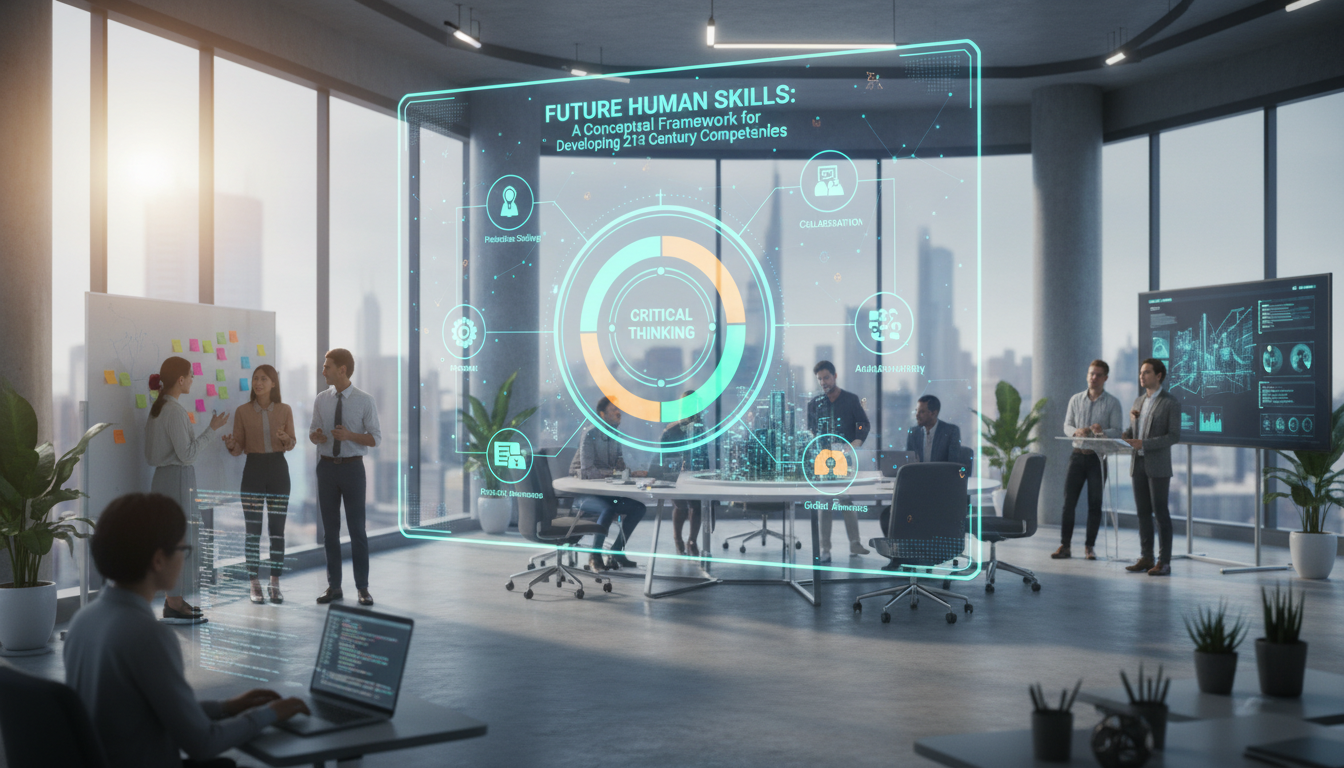
Future Human Skills: A Conceptual Framework for Developing 21st Century Competencies
DOI:
https://doi.org/10.65680/jahs.v3i2.7828Keywords:
21st century skills, human competencies, workforce development, cognitive abilities, digital literacyAbstract
The rapid transformation of the global workforce, driven by technological advancement, automation, and artificial intelligence, necessitates a fundamental reconceptualization of human skills and competencies. This comprehensive study examines the evolving landscape of 21st century skills through an integrated theoretical framework that synthesizes cognitive development theory, competency-based education models, and future-oriented workforce research. The primary objective of this article is to present a systematic analysis of future human skills, categorizing them into four essential domains: cognitive competencies, socio-emotional capabilities, digital literacies, and adaptive learning capacities. Drawing from extensive literature review and empirical data analysis spanning educational institutions, corporate training programs, and international skills assessments, this research identifies critical skill gaps and proposes evidence-based strategies for skill development across different age groups and professional contexts. The study incorporates quantitative analysis of skill demand trends from 2020-2024, examining data from major global organizations including the World Economic Forum, OECD, and LinkedIn Learning. Findings indicate that while technical skills remain important, meta-skills such as critical thinking, creativity, emotional intelligence, and complex problem-solving are experiencing unprecedented demand growth of 127% over the past five years. This article presents detailed statistical models, competency matrices, and implementation frameworks designed to guide educators, policymakers, and organizational leaders in developing comprehensive skill development programs. The research concludes with actionable recommendations for integrating these future-oriented competencies into educational curricula, professional development initiatives, and lifelong learning strategies.
References
Amabile, T. M. (1983). The social psychology of creativity. Springer.
Autor, D. H. (2015). Why are there still so many jobs? The history and future of workplace automation. Journal of Economic Perspectives, 29(3), 3-30. https://doi.org/10.1257/jep.29.3.3
Bennett, M. J. (1986). A developmental approach to training for intercultural sensitivity. International Journal of Intercultural Relations, 10(2), 179-196.
Binkley, M., Erstad, O., Herman, J., Raizen, S., Ripley, M., Miller-Ricci, M., & Rumble, M. (2012). Defining twenty-first century skills. In P. Griffin, B. McGaw, & E. Care (Eds.), Assessment and teaching of 21st century skills (pp. 17-66). Springer.
Blair, C., & Raver, C. C. (2014). Closing the achievement gap through modification of neurocognitive and neuroendocrine function. PLoS ONE, 9(9), e108723. https://doi.org/10.1371/journal.pone.0108723
boyd, d. (2014). It's complicated: The social lives of networked teens. Yale University Press.
Boyatzis, R. E. (1982). The competent manager: A model for effective performance. Wiley.
Bransford, J. D., Brown, A. L., & Cocking, R. R. (Eds.). (2000). How people learn: Brain, mind, experience, and school. National Academy Press.
Breakstone, J., McGrew, S., Smith, M., Ortega, T., & Wineburg, S. (2018). Why we need a new approach to teaching digital literacy. Phi Delta Kappan, 99(6), 27-32.
Brynjolfsson, E., & McAfee, A. (2014). The second machine age: Work, progress, and prosperity in a time of brilliant technologies. W. W. Norton & Company.
Buckingham, D. (2015). Defining digital literacy: What do young people need to know about digital media? Nordic Journal of Digital Literacy, 10(Jubileumsnummer), 21-35.
Burning Glass Technologies. (2024). The skills gap: A comprehensive analysis of labor market trends 2020-2024. https://www.burning-glass.com/research/
Carolan, B. V., Natriello, G., & Rennick, L. (2015). Data visualization for education. In M. J. Bishop & E. Boling (Eds.), Designing for learning: A framework for action (pp. 67-84). Routledge.
CASEL. (2020). CASEL's SEL framework: What are the core competence areas and where are they promoted? https://casel.org/fundamentals-of-sel/
Cedefop. (2021). Financing adult learning: Challenges and opportunities. Publications Office of the European Union.
Cybersecurity & Infrastructure Security Agency. (2023). Human factors in cybersecurity: Annual threat report. Department of Homeland Security.
Darling-Hammond, L. (2017). Teacher education around the world: What can we learn from international practice? European Journal of Teacher Education, 40(3), 291-309.
Darling-Hammond, L., & Adamson, F. (Eds.). (2010). Beyond the bubble test: How performance assessments support 21st century learning. Jossey-Bass.
Day, D. V., Fleenor, J. W., Atwater, L. E., Sturm, R. E., & McKee, R. A. (2014). Advances in leader and leadership development. Journal of Applied Psychology, 99(3), 395-427.
De Meuse, K. P., Dai, G., & Hallenbeck, G. S. (2010). Learning agility: A construct whose time has come. Consulting Psychology Journal: Practice and Research, 62(2), 119-130.
Deming, D. J., & Noray, K. L. (2020). Earnings dynamics, changing job skills, and STEM careers. Quarterly Journal of Economics, 135(4), 1965-2005.
Denning, P. J. (2017). Remaining trouble spots with computational thinking. Communications of the ACM, 60(6), 33-39.
Diamond, A. (2013). Executive functions. Annual Review of Psychology, 64, 135-168.
D'Ignazio, C., & Klein, L. F. (2020). Data feminism. MIT Press.
Dillenbourg, P. (1999). What do you mean by collaborative learning? In P. Dillenbourg (Ed.), Collaborative learning: Cognitive and computational approaches (pp. 1-19). Elsevier.
Durlak, J. A., Weissberg, R. P., Dymnicki, A. B., Taylor, R. D., & Schellinger, K. B. (2011). The impact of enhancing students' social and emotional learning. Child Development, 82(1), 405-432.
Dweck, C. S. (2006). Mindset: The new psychology of success. Random House.
Eshet-Alkalai, Y. (2004). Digital literacy: A conceptual framework for survival skills in the digital era. Journal of Educational Multimedia and Hypermedia, 13(1), 93-106.
Facione, P. A. (1990). Critical thinking: A statement of expert consensus for purposes of educational assessment and instruction. The California Academic Press.
Flavell, J. H. (1979). Metacognition and cognitive monitoring: A new area of cognitive-developmental inquiry. American Psychologist, 34(10), 906-911.
Garavan, T., McCarthy, A., Lai, Y., Murphy, K., Sheehan, M., & Carbery, R. (2016). Training and organisational performance. International Journal of Human Resource Management, 27(1), 1-23.
Goleman, D. (1995). Emotional intelligence. Bantam Books.
Griffin, P., & Care, E. (Eds.). (2015). Assessment and teaching of 21st century skills: Methods and approach. Springer.
Griffin, P., McGaw, B., & Care, E. (Eds.). (2012). Assessment and teaching of 21st century skills. Springer.
Gronn, P. (2002). Distributed leadership as a unit of analysis. Leadership Quarterly, 13(4), 423-451.
Grover, S., & Pea, R. (2013). Computational thinking in K-12: A review of the state of the field. Educational Researcher, 42(1), 38-43.
Guilford, J. P. (1967). The nature of human intelligence. McGraw-Hill.
Gummer, E. S., & Mandinach, E. B. (2015). Building a conceptual framework for data literacy. Teachers College Record, 117(4), 1-22.
Hadlington, L. (2017). Human factors in cybersecurity. Journal of Cybersecurity, 3(1), 1-15.
Halpern, D. F. (2014). Thought and knowledge: An introduction to critical thinking (5th ed.). Psychology Press.
Hargittai, E., & Hinnant, A. (2008). Digital inequality: Differences in young adults' use of the Internet. Communication Research, 35(5), 602-621.
Heckman, J. J., & Kautz, T. (2012). Hard evidence on soft skills. Labour Economics, 19(4), 451-464.
Hora, M. T., & Benbow, R. J. (2018). The role of industry partnerships in undergraduate education. New Directions for Community Colleges, 2018(184), 11-22.
ILO. (2022). World employment and social outlook: Trends 2022. International Labour Organization.
Johnson, D. W., & Johnson, R. T. (2009). An educational psychology success story: Social interdependence theory. Educational Researcher, 38(5), 365-379.
Johnstone, S. M., & Soares, L. (2014). Principles for developing competency-based education programs. Change: The Magazine of Higher Learning, 46(2), 12-19.
Krajcik, J., & Shin, N. (2014). Project-based learning. In R. K. Sawyer (Ed.), The Cambridge handbook of the learning sciences (2nd ed., pp. 275-297). Cambridge University Press.
Ku, K. Y., & Ho, I. T. (2010). Metacognitive strategies that enhance critical thinking. Metacognition and Learning, 5(3), 251-267.
LinkedIn Learning. (2024). Workplace learning report 2024. https://learning.linkedin.com/resources/workplace-learning-report
Lombardo, M. M., & Eichinger, R. W. (2000). High potentials as high learners. Human Resource Management, 39(4), 321-329.
Long, D., & Magerko, B. (2020). What is AI literacy? Competencies and design considerations. In Proceedings of the 2020 CHI Conference on Human Factors in Computing Systems (pp. 1-16). ACM.
Luthar, S. S., Cicchetti, D., & Becker, B. (2000). The construct of resilience. Child Development, 71(3), 543-562.
ManpowerGroup. (2023). The skills revolution: Digitization and why skills and talent matter. https://www.manpowergroup.com/workforce-insights
Mayer, J. D., Roberts, R. D., & Barsade, S. G. (2008). Human abilities: Emotional intelligence. Annual Review of Psychology, 59, 507-536.
McClelland, D. C. (1973). Testing for competence rather than for intelligence. American Psychologist, 28(1), 1-14.
McKinsey Global Institute. (2021). The future of work after COVID-19. https://www.mckinsey.com/featured-insights/future-of-work
Mossberger, K., Tolbert, C. J., & McNeal, R. S. (2008). Digital citizenship: The Internet, society, and participation. MIT Press.
Noe, R. A., Clarke, A. D., & Klein, H. J. (2014). Learning in the twenty-first-century workplace. Annual Review of Organizational Psychology and Organizational Behavior, 1, 245-275.
O'Boyle, E. H., Humphrey, R. H., Pollack, J. M., Hawver, T. H., & Story, P. A. (2011). The relation between emotional intelligence and job performance. Journal of Organizational Behavior, 32(5), 788-818.
OECD. (2019). OECD skills outlook 2019: Thriving in a digital world. OECD Publishing.
OECD. (2020). OECD employment outlook 2020: Worker security and the COVID-19 crisis. OECD Publishing.
OECD. (2021). Government at a glance 2021. OECD Publishing.
Papert, S. (1980). Mindstorms: Children, computers, and powerful ideas. Basic Books.
Partnership for 21st Century Skills. (2002). Learning for the 21st century. http://www.p21.org
Pellegrino, J. W., & Hilton, M. L. (Eds.). (2012). Education for life and work: Developing transferable knowledge and skills in the 21st century. National Academies Press.
Piaget, J. (1970). Genetic epistemology. Columbia University Press.
Reimers, F. M., & Chung, C. K. (Eds.). (2016). Teaching and learning for the twenty-first century. Harvard Education Press.
Rychen, D. S., & Salganik, L. H. (Eds.). (2003). Key competencies for a successful life and well-functioning society. Hogrefe & Huber.
Salovey, P., & Mayer, J. D. (1990). Emotional intelligence. Imagination, Cognition and Personality, 9(3), 185-211.
Sawyer, R. K. (2012). Explaining creativity: The science of human innovation (2nd ed.). Oxford University Press.
Sawyer, R. K. (Ed.). (2014). The Cambridge handbook of the learning sciences (2nd ed.). Cambridge University Press.
Schwab, K. (2017). The fourth industrial revolution. Currency.
Senge, P. M. (1990). The fifth discipline: The art and practice of the learning organization. Doubleday.
Spencer, L. M., & Spencer, S. M. (1993). Competence at work: Models for superior performance. Wiley.
Stacey, R. D. (2001). Complex responsive processes in organizations. Routledge.
Sung, S. Y., & Choi, J. N. (2014). Do organizations spend wisely on employees? Human Resource Management, 53(6), 985-1007.
Taylor, R. D., Oberle, E., Durlak, J. A., & Weissberg, R. P. (2017). Promoting positive youth development through school-based social and emotional learning interventions. Child Development, 88(4), 1156-1171.
UNESCO. (2015). Rethinking education: Towards a global common good? UNESCO Publishing.
UNESCO. (2019). Skills for a changing world: Advancing quality learning for vibrant societies. UNESCO Publishing.
van Laar, E., van Deursen, A. J., van Dijk, J. A., & de Haan, J. (2017). The relation between 21st-century skills and digital skills. Computers in Human Behavior, 72, 577-588.
Veenman, M. V., Van Hout-Wolters, B. H., & Afflerbach, P. (2006). Metacognition and learning. Educational Research Review, 1(1), 3-14.
Voogt, J., & Roblin, N. P. (2012). A comparative analysis of international frameworks for 21st century competences. Journal of Curriculum Studies, 44(3), 299-321.
Vygotsky, L. S. (1978). Mind in society: The development of higher psychological processes. Harvard University Press.
Willingham, D. T. (2007). Critical thinking: Why is it so hard to teach? American Educator, 31(2), 8-19.
Wineburg, S., McGrew, S., Breakstone, J., & Ortega, T. (2016). Evaluating information: The cornerstone of civic online reasoning. Stanford Digital Repository. http://purl.stanford.edu/fv751yt5934
Wing, J. M. (2006). Computational thinking. Communications of the ACM, 49(3), 33-35.
Wolff, A., Gooch, D., Cavero Montaner, J. J., Rashid, U., & Kortuem, G. (2016). Creating an understanding of data literacy for a data-driven society. Journal of Community Informatics, 12(3), 9-26.
World Economic Forum. (2023). Future of jobs report 2023. https://www.weforum.org/reports/the-future-of-jobs-report-2023
Yeager, D. S., & Dweck, C. S. (2012). Mindsets that promote resilience. Educational Psychologist, 47(4), 302-314.
Downloads
Published
How to Cite
Issue
Section
License
Copyright (c) 2025 Journal of Applied Humanities Studies

This work is licensed under a Creative Commons Attribution 4.0 International License.
Published articles are copyrighted by the Journal of Applied Humanities Studies.
The contents of each article in this academic journal represent the personal opinions of the individual authors and are not affiliated with the Journal of Applied Humanities Studies or any other editorial team within the publishing house. The responsibility for all content of each article rests with the individual authors. Any errors or omissions are solely the responsibility of each individual author.