A Model for Developing Temple Schools Using Buddhist Philosophy for Educational Sustainability
DOI:
https://doi.org/10.65680/jahs.v3i2.7827Keywords:
Temple schools, Buddhist philosophy, Educational sustainability, Thailand education, School development modelAbstract
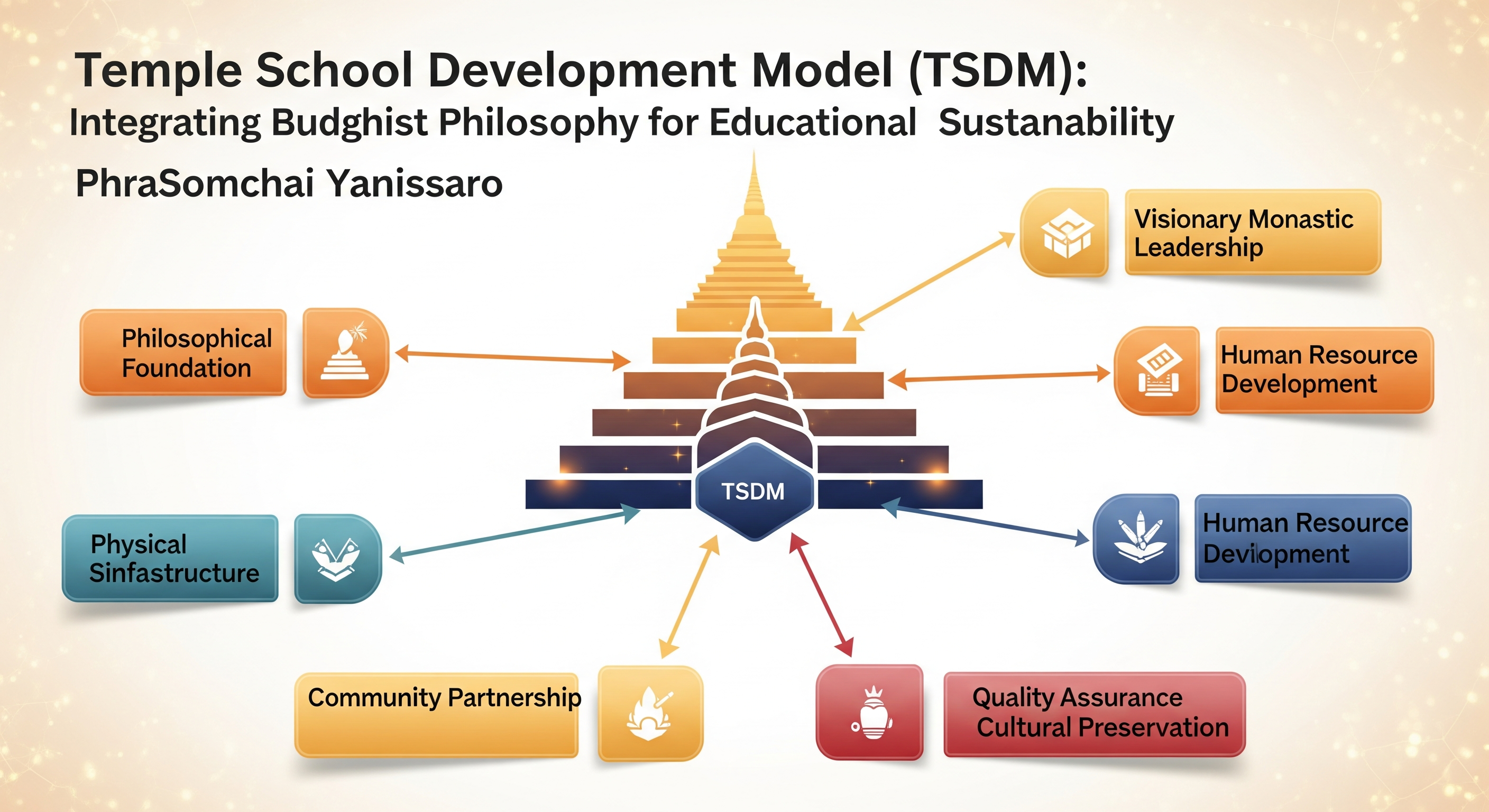
This research investigates the development of a comprehensive model for temple schools in Thailand that integrates Buddhist philosophy with modern educational sustainability principles. Temple schools (Wat schools) have historically played a crucial role in Thai education, serving as centers of learning and moral development for centuries. However, contemporary challenges including rapid globalization, technological advancement, and shifting social values have created significant pressures on these traditional institutions. This study employs a mixed-methods approach combining qualitative case studies of twelve successful temple schools across Thailand with quantitative surveys of 450 stakeholders including monks, teachers, students, and community members. The research aims to identify key success factors, develop an operational framework, and establish sustainability indicators for temple school development. Findings reveal that successful temple schools demonstrate five critical dimensions: spiritual-academic integration (combining Buddhist teachings with national curriculum requirements), community engagement mechanisms, sustainable resource management, teacher development programs rooted in Buddhist pedagogy, and adaptive leadership structures. The resulting Temple School Development Model (TSDM) provides a structured framework incorporating eight components: philosophical foundation, curriculum integration, human resource development, physical infrastructure, financial sustainability, community partnership, quality assurance, and cultural preservation. Statistical analysis demonstrates significant positive correlations between Buddhist philosophy integration and student well-being (r=0.78, p<0.001), academic performance (r=0.65, p<0.01), and community satisfaction (r=0.82, p<0.001). The model offers practical guidelines for temple schools seeking to balance traditional Buddhist values with contemporary educational demands while ensuring long-term sustainability.
References
Braun, V., & Clarke, V. (2006). Using thematic analysis in psychology. Qualitative Research in Psychology, 3(2), 77-101. https://doi.org/10.1191/1478088706qp063oa
Bryk, A. S., Lee, V. E., & Holland, P. B. (1993). Catholic schools and the common good. Harvard University Press.
Bryk, A. S., Sebring, P. B., Allensworth, E., Luppescu, S., & Easton, J. Q. (2010). Organizing schools for improvement: Lessons from Chicago. University of Chicago Press.
Cholvijarn, W. (2020). Buddhist education in contemporary Thailand: Challenges and opportunities. Journal of Buddhist Education and Research, 6(1), 45-62.
Creswell, J. W., & Clark, V. L. P. (2018). Designing and conducting mixed methods research (3rd ed.). SAGE Publications.
Delors, J., Al Mufti, I., Amagi, I., Carneiro, R., Chung, F., Geremek, B., Gorham, W., Kornhauser, A., Manley, M., Padrón Quero, M., Savané, M., Singh, K., Stavenhagen, R., Won Suhr, M., & Nanzhao, Z. (1996). Learning: The treasure within. UNESCO Publishing.
Glaser, B. G., & Strauss, A. L. (1967). The discovery of grounded theory: Strategies for qualitative research. Aldine Publishing Company.
Hefner, R. W., & Zaman, M. Q. (Eds.). (2017). Schooling Islam: The culture and politics of modern Muslim education. Princeton University Press.
Hu, L. T., & Bentler, P. M. (1999). Cutoff criteria for fit indexes in covariance structure analysis: Conventional criteria versus new alternatives. Structural Equation Modeling: A Multidisciplinary Journal, 6(1), 1-55. https://doi.org/10.1080/10705519909540118
Jeynes, W. H. (2012). A meta-analysis on the effects and contributions of public, public charter, and religious schools on student outcomes. Peabody Journal of Education, 87(3), 305-335. https://doi.org/10.1080/0161956X.2012.679542
Johnson, R. B., & Onwuegbuzie, A. J. (2004). Mixed methods research: A research paradigm whose time has come. Educational Researcher, 33(7), 14-26. https://doi.org/10.3102/0013189X033007014
Keyes, C. F. (1989). Buddhist politics and their revolutionary origins in Thailand. International Political Science Review, 10(2), 121-142. https://doi.org/10.1177/019251218901000203
Leithwood, K., & Jantzi, D. (2019). Transformational school leadership effects: A replication. School Effectiveness and School Improvement, 10(4), 451-479. https://doi.org/10.1076/sesi.10.4.451.3495
Ministry of Education Thailand. (2017). National education standards and quality assessment 2018. Office of the Basic Education Commission.
Nunnally, J. C., & Bernstein, I. H. (1994). Psychometric theory (3rd ed.). McGraw-Hill.
Office of National Buddhism. (2024). Annual statistics of Buddhist educational institutions in Thailand. Ministry of Culture.
Office of the National Economic and Social Development Council. (2023). Poverty and inequality in Thailand 2023. Prime Minister's Office.
Phongpaichit, P., & Baker, C. (2018). A history of Thailand (3rd ed.). Cambridge University Press.
Putnam, R. D. (2000). Bowling alone: The collapse and revival of American community. Simon & Schuster.
Roeser, R. W., Mashburn, A. J., Skinner, E. A., Domitrovich, C., Williford, A., & Greenberg, M. (2023). Mindfulness and contemplative pedagogy in higher education. Review of Research in Education, 47(1), 258-301. https://doi.org/10.3102/0091732X231154313
Schonert-Reichl, K. A., Oberle, E., Lawlor, M. S., Abbott, D., Thomson, K., Oberlander, T. F., & Diamond, A. (2020). Enhancing cognitive and social-emotional development through a simple-to-administer mindfulness-based school program for elementary school children: A randomized controlled trial. Developmental Psychology, 51(1), 52-66. https://doi.org/10.1037/a0038454
Stake, R. E. (2006). Multiple case study analysis. Guilford Press.
Sukhonthanasan, P., Rattanasiripong, K., & Wongchai, S. (2021). Challenges facing Buddhist temple schools in Thailand: An empirical investigation. Journal of Southeast Asian Education, 17(2), 134-158.
Taweesuk, A. (2019). Administrative practices of temple schools in Thailand. International Journal of Educational Management, 33(4), 678-695. https://doi.org/10.1108/IJEM-09-2018-0278
UNESCO Bangkok. (2021). One year into COVID: Thailand's education response. UNESCO Regional Office for Asia and the Pacific.
United Nations. (2015). Transforming our world: The 2030 agenda for sustainable development. UN General Assembly Resolution A/RES/70/1.
Wyatt, D. K. (2003). Thailand: A short history (2nd ed.). Yale University Press.
Yamane, T. (1967). Statistics: An introductory analysis (2nd ed.). Harper and Row.
Yin, R. K. (2018). Case study research and applications: Design and methods (6th ed.). SAGE Publications.
Downloads
Published
How to Cite
Issue
Section
License
Copyright (c) 2025 Journal of Applied Humanities Studies

This work is licensed under a Creative Commons Attribution 4.0 International License.
Published articles are copyrighted by the Journal of Applied Humanities Studies.
The contents of each article in this academic journal represent the personal opinions of the individual authors and are not affiliated with the Journal of Applied Humanities Studies or any other editorial team within the publishing house. The responsibility for all content of each article rests with the individual authors. Any errors or omissions are solely the responsibility of each individual author.