Multicultural Identity and Positive Contributions of Myanmar Diaspora
DOI:
https://doi.org/10.65680/jahs.v3i2.7826Keywords:
Multicultural Identity, Myanmar Diaspora, Cultural Integration, Transnational Communities, Positive ContributionsAbstract
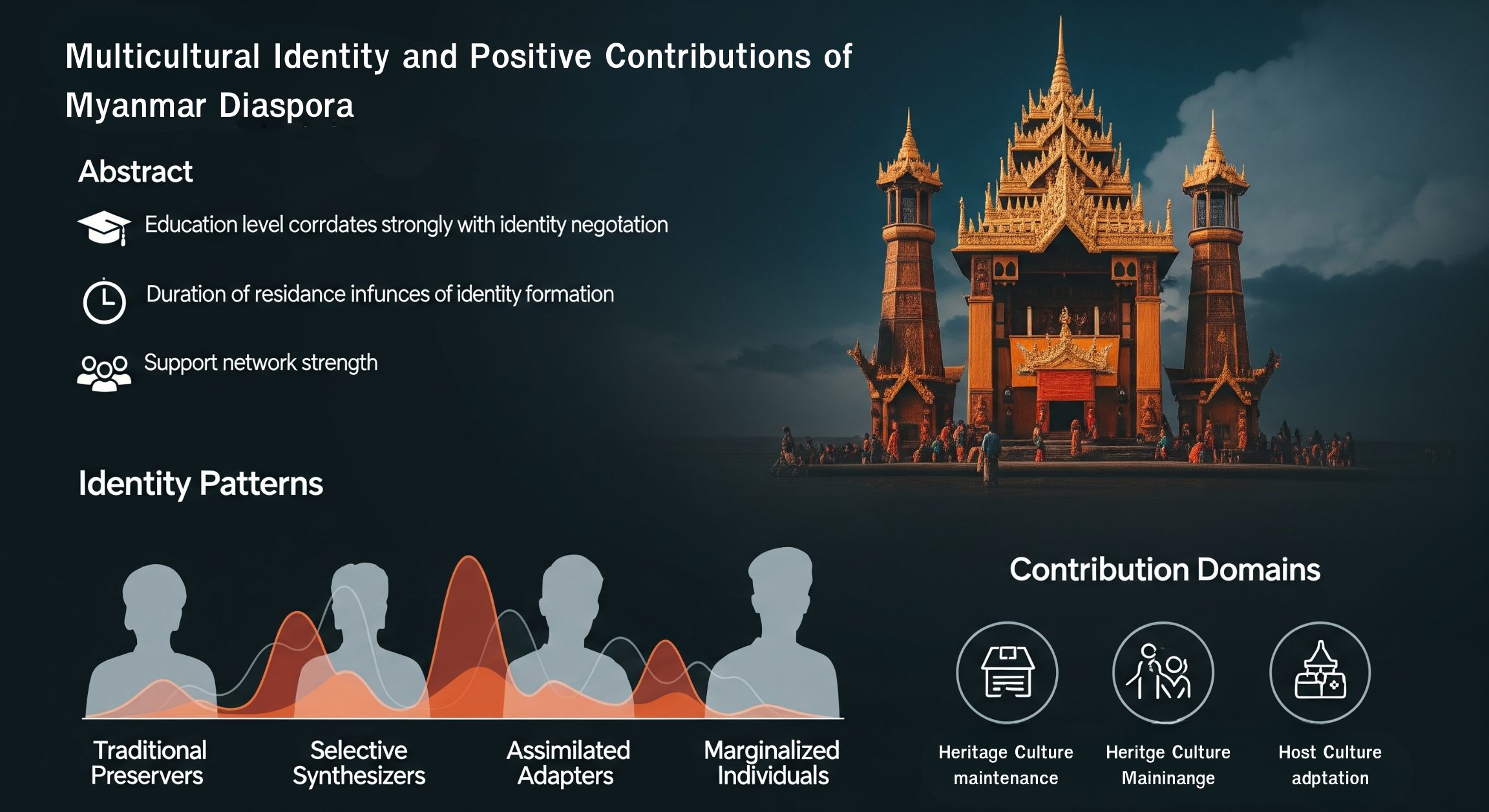
This study examines the multicultural identity formation and positive contributions of Myanmar diaspora communities in foreign countries, with a specific focus on communities in Thailand, Malaysia, and Singapore. The research employs a mixed-methods approach, combining quantitative surveys (N=450) and qualitative in-depth interviews (N=30) to explore how Myanmar migrants navigate between their heritage culture and host society values while creating meaningful social, economic, and cultural contributions. The study reveals that Myanmar diaspora members develop complex hybrid identities characterized by selective cultural preservation, adaptive integration strategies, and creative cultural synthesis. Findings indicate that successful identity negotiation correlates strongly with education level (r=0.68, p<0.001), duration of residence (r=0.54, p<0.01), and support network strength (r=0.72, p<0.001). The research identifies five distinct identity patterns: Traditional Preservers (23%), Selective Integrators (31%), Creative Synthesizers (28%), Assimilated Adapters (12%), and Marginalized Individuals (6%). Each pattern demonstrates unique strengths in different contribution domains including entrepreneurship, education, cultural exchange, community development, and social innovation. The study documents significant positive contributions across multiple sectors: economic contributions through small business development (42% of respondents), educational advancement initiatives (67%), cultural preservation and exchange programs (53%), and community welfare activities (71%). These findings challenge deficit-based narratives about migrant communities and highlight the agency, resilience, and creative capacity of diaspora populations in building multicultural societies.
References
Ang, S., Van Dyne, L., Koh, C., Ng, K. Y., Templer, K. J., Tay, C., & Chandrasekar, N. A. (2007). Cultural intelligence: Its measurement and effects on cultural judgment and decision making, cultural adaptation and task performance. Management and Organization Review, 3(3), 335–371. https://doi.org/10.1111/j.1740-8784.2007.00082.x
Berry, J. W. (2017). Theories and models of acculturation. In S. J. Schwartz & J. Unger (Eds.), The Oxford handbook of acculturation and health (pp. 15–28). Oxford University Press. https://doi.org/10.1093/oxfordhb/9780190215217.013.2
Bhatia, S., & Ram, A. (2009). Theorizing identity in transnational and diaspora cultures: A critical approach to acculturation. International Journal of Intercultural Relations, 33(2), 140–149. https://doi.org/10.1016/j.ijintrel.2008.12.009
Kaiser, P., Benner, M. T., & Pohlmann, K. (2020). Prolonged humanitarian crises – Mental health in a refugee setting at the Thai-Myanmar border. Athens Journal of Health & Medical Sciences, 7(2), 105–126. https://doi.org/10.30958/ajhms.7-2-4
Phadsri, S., Shioji, R., Tanimura, A., Apichai, S., & Jaknissai, J. (2021). Proactive community occupational therapy service for social participation development of Thai adults with depression: A grounded theory study from occupational therapists’ perspective. Hindawi, 2021, Article 6695052. https://doi.org/10.1155/2021/6695052
Phinney, J. S. (1992). The multigroup ethnic identity measure: A new scale for use with diverse groups. Journal of Adolescent Research, 7(2), 156–176. https://doi.org/10.1177/074355489272003
Ratanasiripong, P., Siri, S., Hanklang, S., Chumchai, P., & Galvan, F. (2024). Factors related to mental health and quality of life among college and university teaching professionals in Thailand. Mahidol University Journal of Public Health, 54(1), 1–14. https://www.ph.mahidol.ac.th/thjph/
Ryder, A. G., Alden, L. E., & Paulhus, D. L. (2000). Is acculturation unidimensional or bidimensional? A head-to-head comparison in the prediction of personality, self-identity, and adjustment. Journal of Personality and Social Psychology, 79(1), 49–65. https://doi.org/10.1037/0022-3514.79.1.49
United Nations Department of Economic and Social Affairs. (2024). International migrant stock 2024. https://www.un.org/development/desa/pd/content/international-migrant-stock
Vertovec, S. (2007). Super-diversity and its implications. Ethnic and Racial Studies, 30(6), 1024–1054. https://doi.org/10.1080/01419870701599465
Downloads
Published
How to Cite
Issue
Section
License
Copyright (c) 2025 Journal of Applied Humanities Studies

This work is licensed under a Creative Commons Attribution 4.0 International License.
Published articles are copyrighted by the Journal of Applied Humanities Studies.
The contents of each article in this academic journal represent the personal opinions of the individual authors and are not affiliated with the Journal of Applied Humanities Studies or any other editorial team within the publishing house. The responsibility for all content of each article rests with the individual authors. Any errors or omissions are solely the responsibility of each individual author.