Promoting Emotional Development of Early Childhood on Buddhist Psychology Principles
DOI:
https://doi.org/10.65680/jahs.v2i1.7703Keywords:
Buddhist psychology, emotional development, early childhood, early childhood education, emotional management, mindfulnessAbstract
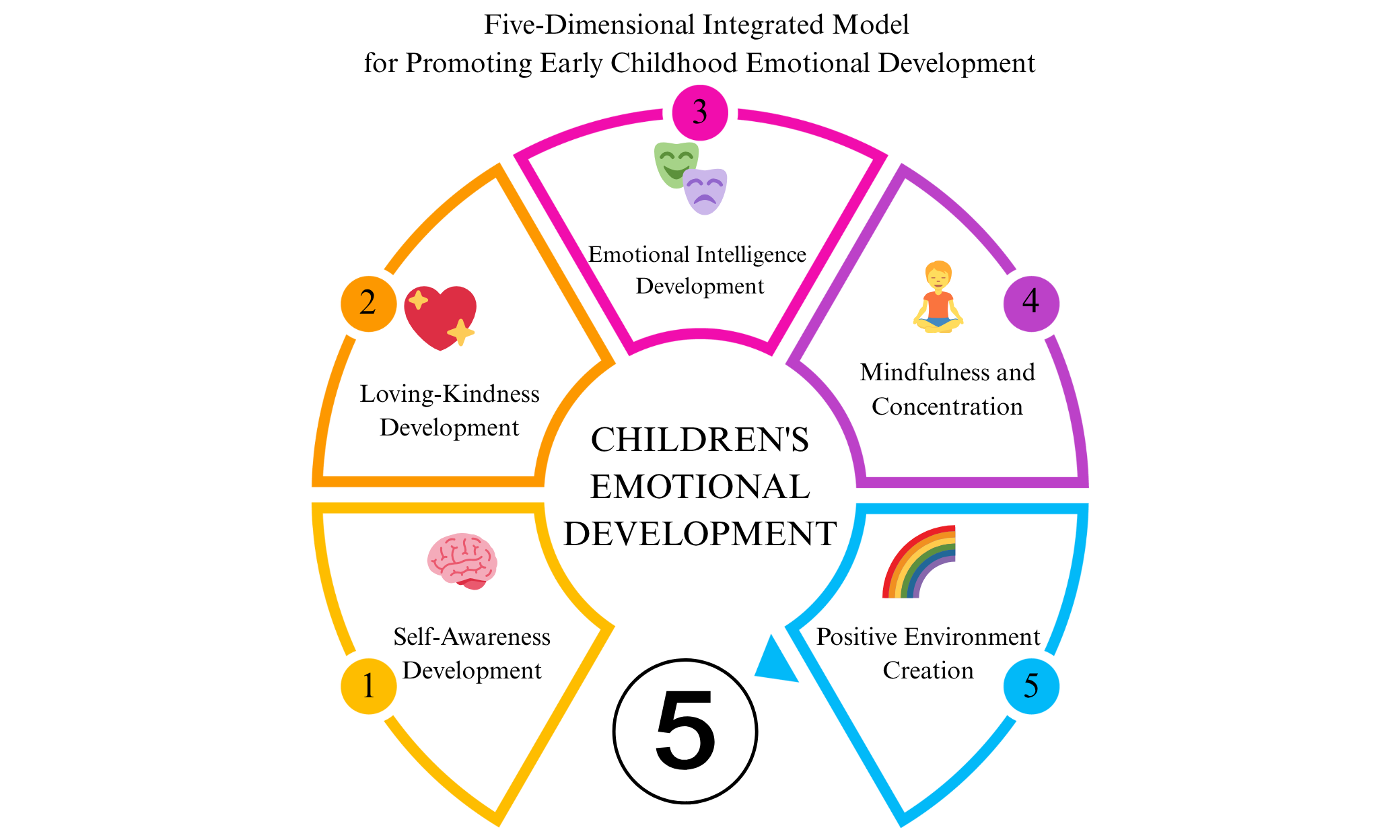
Early childhood is a critical period for foundational emotional development that significantly impacts lifelong growth. Buddhist psychology, a wisdom tradition accumulated over 2,500 years since the Buddha's time, contains principles and concepts that can be effectively applied to promote emotional development in early childhood. This academic article aims to study and analyze Buddhist psychology concepts related to early childhood emotional development, synthesize relevant research and theories, and propose an integrated model for promoting emotional development based on Buddhist psychology. This study employs documentary analysis and synthesis of concepts from diverse secondary sources, including academic research, religious documents, and reports from international organizations published between 2020-2024, totaling 52 documents. The research findings reveal that Buddhist psychology principles applicable to promoting emotional development in early childhood comprise four main dimensions: mindfulness, loving-kindness, wisdom, and concentration. Integrating these principles into age-appropriate learning activities promotes the development of emotional management skills, self and others' emotional awareness, positive relationship building, and social adaptation. This article proposes a Five-Dimensional Integrated Model for promoting emotional development in early childhood, covering dimensions of self-awareness development, loving-kindness and compassion development, emotional intelligence development, mindfulness and concentration practice, and positive environment creation. This model can be applied in educational and family contexts to sustainably promote emotional development in early childhood.
References
American Academy of Pediatrics, American Academy of Child and Adolescent Psychiatry, & Children's Hospital Association. (2021). Declaration of a national emergency in child and adolescent mental health. American Academy of Pediatrics.
Bazzano, A. N., Sun, Y., Zu, Y., Fleckman, J. M., Blackson, E. A., Patel, T., & Roi, C. (2023). Yoga and mindfulness for social-emotional development and resilience in 3–5 year-old children: A non-randomised, controlled intervention. Psychology Research and Behaviour Management, 16, 109–118. https://doi.org/10.2147/PRBM.S394055
Beck, A. T. (2011). Cognitive behavior therapy: Basics and beyond (2nd ed.). Guilford Press.
Berger, R., Benatov, J., Karna, A., Wu, R., Tarrasch, R., van Schaik, S. D. M., & Brenick, A. (2024). Cultivating compassion in Jewish-Israeli kindergartners: The effectiveness of mindfulness- and empathy-based interventions as facilitators of compassion. Early Education and Development, 35(8), 1353–1373. https://doi.org/10.1080/10409289.2024.2360883
Berti, S., & Cigala, A. (2022). Mindfulness for preschoolers: Effects on prosocial behaviour, self-regulation and perspective taking. Early Education and Development, 33(1), 38–57. https://doi.org/10.1080/10409289.2020.1735459
Blair, C., & Dennis, T. (2010). An optimal balance: The integration of emotion and cognition in context. In S. D. Calkins & M. A. Bell (Eds.), Child development at the intersection of emotion and cognition (pp. 17–35). American Psychological Association.
Bockmann, J. O., & Yu, S. Y. (2023). Using mindfulness-based interventions to support self-regulation in young children: A review of the literature. Early Childhood Education Journal, 51(4), 693–703. https://doi.org/10.1007/s10643-022-01333-2
Bowlby, J. (1988). A secure base: Parent-child attachment and healthy human development. Basic Books.
Calkins, S. D., & Fox, N. A. (2002). Self-regulatory processes in early personality development: A multilevel approach to the study of childhood social withdrawal and aggression. Development and Psychopathology, 14(3), 477–498. https://doi.org/10.1017/S095457940200305X
Cole, P. M., Dennis, T. A., Smith-Simon, K. E., & Cohen, L. H. (2009). Preschoolers' emotion regulation strategy understanding: Relations with emotion socialization and child self-regulation. Social Development, 18(2), 324–352. https://doi.org/10.1111/j.1467-9507.2008.00503.x
Courbet, O., Daviot, Q., Kalamarides, V., Habib, M., & Villemonteix, T. (2024). Promoting psychological well-being in preschoolers through mindfulness-based socio-emotional learning: A randomized-controlled trial. Research on Child and Adolescent Psychopathology, 52(10), 1487–1502. https://doi.org/10.1007/s10802-024-01220-x
Crooks, C. V., Bax, K., Delaney, A., Kim, H., & Shokoohi, M. (2020). Impact of MindUP among young children: Improvements in behavioral problems, adaptive skills, and executive functioning. Mindfulness, 11(10), 2433–2444. https://doi.org/10.1007/s12671-020-01460-0
Denham, S. A. (2007). Dealing with feelings: How children negotiate the worlds of emotions and social relationships. Cognition, Brain, Behavior, 11(1), 1–48.
Denham, S. A., & Brown, C. (2010). "Plays nice with others": Social–emotional learning and academic success. Early Education and Development, 21(5), 652–680. https://doi.org/10.1080/10409289.2010.497450
Denham, S. A., Bassett, H. H., Zinsser, K., & Wyatt, T. M. (2015). How preschoolers' social-emotional learning predicts their early school success: Developing theory-promoting, competency-based assessments. Infant and Child Development, 23(4), 426–454. https://doi.org/10.1002/icd.1840
Eisenberg, N., Spinrad, T. L., & Eggum, N. D. (2010). Emotion-related self-regulation and its relation to children's maladjustment. Annual Review of Clinical Psychology, 6, 495–525. https://doi.org/10.1146/annurev.clinpsy.121208.131208
Flook, L., Goldberg, S. B., Pinger, L., & Davidson, R. J. (2015). Promoting prosocial behavior and self-regulatory skills in preschool children through a mindfulness-based kindness curriculum. Developmental Psychology, 51(1), 44–51. https://doi.org/10.1037/a0038256
Fredrickson, B. L., Cohn, M. A., Coffey, K. A., Pek, J., & Finkel, S. M. (2008). Open hearts build lives: Positive emotions, induced through loving-kindness meditation, build consequential personal resources. Journal of Personality and Social Psychology, 95(5), 1045–1062. https://doi.org/10.1037/a0013262
Gottman, J. M., Katz, L. F., & Hooven, C. (1996). Parental meta-emotion philosophy and the emotional life of families: Theoretical models and preliminary data. Journal of Family Psychology, 10(3), 243–268. https://doi.org/10.1037/0893-3200.10.3.243
Hayes, S. C., Strosahl, K. D., & Wilson, K. G. (2012). Acceptance and commitment therapy: The process and practice of mindful change (2nd ed.). Guilford Press.
Hofmann, S. G., Sawyer, A. T., Witt, A. A., & Oh, D. (2010). The effect of mindfulness-based therapy on anxiety and depression: A meta-analytic review. Journal of Consulting and Clinical Psychology, 78(2), 169–183. https://doi.org/10.1037/a0018555
Hölzel, B. K., Carmody, J., Vangel, M., Congleton, C., Yerramsetti, S. M., Gard, T., & Lazar, S. W. (2011). Mindfulness practice leads to increases in regional brain gray matter density. Psychiatry Research: Neuroimaging, 191(1), 36–43. https://doi.org/10.1016/j.pscychresns.2010.08.006
Kabat-Zinn, J. (2003). Mindfulness-based interventions in context: Past, present, and future. Clinical Psychology: Science and Practice, 10(2), 144–156. https://doi.org/10.1093/clipsy.bpg016
Kander, T. N., Lawrence, D., Fox, A., Houghton, S., & Becerra, R. (2024). Mindfulness-based interventions for preadolescent children: A comprehensive meta-analysis. Journal of School Psychology, 102, Article 101261. https://doi.org/10.1016/j.jsp.2023.101261
Mesquita, B., & Frijda, N. H. (1992). Cultural variations in emotions: A review. Psychological Bulletin, 112(2), 179–204. https://doi.org/10.1037/0033-2909.112.2.179
Morris, A. S., Silk, J. S., Steinberg, L., Myers, S. S., & Robinson, L. R. (2007). The role of the family context in the development of emotion regulation. Social Development, 16(2), 361–388. https://doi.org/10.1111/j.1467-9507.2007.00389.x
Neff, K. D. (2014). Self-compassion and psychological well-being. In J. Weintraub (Ed.), Constructs of happiness (pp. 35–57). Springer.
Poehlmann-Tynan, J., Vigna, A., Weymouth, L., Gerstein, E., Burnson, C., Zabransky, M., Lee, P., & Zahn-Waxler, C. (2016). A pilot study of contemplative practices with economically disadvantaged preschoolers: Children's empathic and self-regulatory behaviours. Mindfulness, 7(1), 46–58. https://doi.org/10.1007/s12671-015-0426-3
Radesky, J. S., Schumacher, J., & Zuckerman, B. (2015). Mobile and interactive media use by young children: The good, the bad, and the unknown. Pediatrics, 135(1), 1–3. https://doi.org/10.1542/peds.2014-2251
Slot, P. L., Mulder, H., Verhagen, J., & Leseman, P. P. M. (2017). Preschoolers' cognitive and emotional self-regulation in pretend play: Relations with executive functions and quality of play. Infant and Child Development, 26(6), Article e2038. https://doi.org/10.1002/icd.2038
Thompson, R. A. (2014). Socialization of emotion and emotion regulation in the family. In J. J. Gross (Ed.), Handbook of emotion regulation (2nd ed., pp. 173–186). Guilford Press.
Viglas, M., & Perlman, M. (2018). Effects of a mindfulness-based program on young children's self-regulation, prosocial behavior and hyperactivity. Journal of Child and Family Studies, 27(4), 1150–1161. https://doi.org/10.1007/s10826-017-0971-6
World Health Organization. (2020). Mental health and psychosocial considerations during the COVID-19 outbreak. WHO.
Yanissaro, P. (2023). Application of Buddhist psychology in promoting emotional development of early childhood: A documentary research. Journal of Applied Humanities Studies, 1(2), 14–21. Retrieved from https://so09.tci-thaijo.org/index.php/J_AHS/article/view/6923
Downloads
Published
How to Cite
Issue
Section
License
Copyright (c) 2024 Journal of Applied Humanities Studies

This work is licensed under a Creative Commons Attribution 4.0 International License.
Published articles are copyrighted by the Journal of Applied Humanities Studies.
The contents of each article in this academic journal represent the personal opinions of the individual authors and are not affiliated with the Journal of Applied Humanities Studies or any other editorial team within the publishing house. The responsibility for all content of each article rests with the individual authors. Any errors or omissions are solely the responsibility of each individual author.