Applied Humanities and Youth Development Potential in Temple Schools
DOI:
https://doi.org/10.65680/jahs.v2i1.7580Keywords:
Applied Humanities, Youth Potential Development, Temple Schools, Bavorn Concept, 21st Century SkillsAbstract
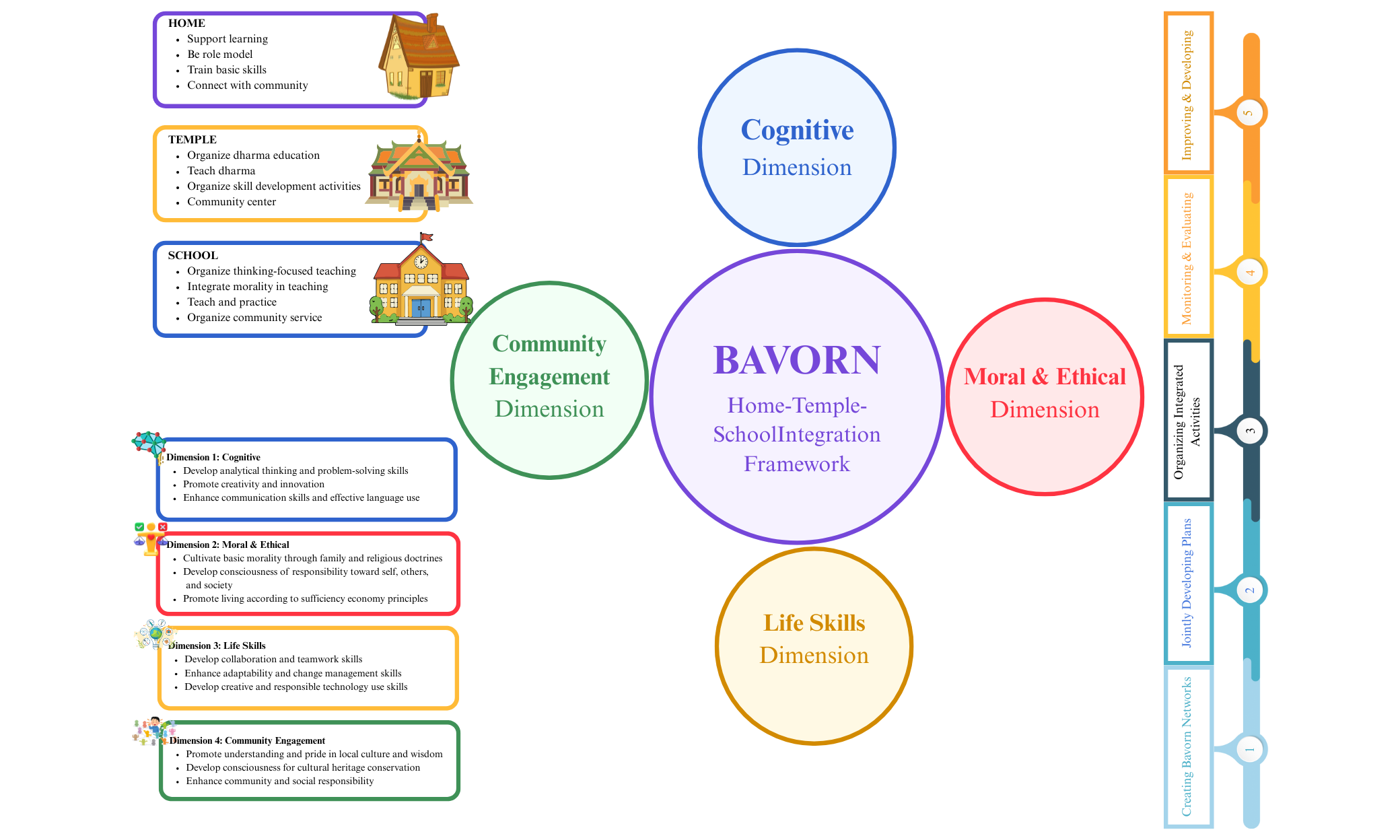
This academic article aims to study and present the application of applied humanities in developing youth potential in the context of temple schools, using the Bavorn concept (Home, Temple, School) as an analytical framework. This study demonstrates that applied humanities can be an essential tool in enhancing 21st-century skills for youth through the integration of humanities knowledge with real-life practice. Temple schools, as educational institutions with deep cultural and religious foundations in Thai society, play a crucial role in developing youth to be knowledgeable and virtuous. Applying the Bavorn concept helps connect learning among home, temple, and school in a systematic integration, resulting in comprehensive youth development across intellectual, emotional, social, and spiritual dimensions. This article proposes a youth potential development model through applied humanities consisting of four main dimensions: cognitive dimension, moral and ethical dimension, life skills dimension, and community engagement dimension. This model can be applied in temple schools and other educational institutions to develop youth to be ready to face 21st-century challenges effectively.
References
British Council Thailand. (2024). What skills do children need in the 21st century. https://www.britishcouncil.or.th/english/tips/general/miscellaneous/what-skills-do-children-need-in-the-21-century
Cubic Creative. (2025). 21st Century Skills. https://cubiccreative.org/21st-century-skill/
Nantiko, P. S. (2023). Enhancing student potential in temple schools through the Bavorn concept: Home, temple, school. Journal of Applied Humanities Studies, 1(2), 1–13. https://so09.tci-thaijo.org/index.php/J_AHS/article/view/6921
National Endowment for the Humanities. (2024). Division of education professional development programs. https://www.neh.gov/divisions/education/summer-programs
Office of Knowledge Management and Development. (2024). Essential skills in the 21st century. https://www.okmd.or.th/okmd-opportunity/new-gen/262/
Office of the Education Council. (2024). Education trends in 2024. Ministry of Education. https://www.onec.go.th/th.php/page/view/Outstand/5501
Phra Chaikang Aphinyo. (2021). Home-temple-school: Core of community development according to royal initiative. Siamrath. https://siamrath.co.th/n/268995
Thammasat University. (2021). How will we develop education for Thai youth to be ready for the 21st century world. Faculty of Learning Sciences and Education. https://tu.ac.th/thammasat-lsed-expert-talk-educational-development-for-21st-century
TruePlookpanya. (2024). Learning skills in the 21st century. https://www.trueplookpanya.com/dhamma/content/66054
USAID. (2024). Involving youth in positive youth development. Youth.gov. https://youth.gov/youth-topics/involving-youth-positive-youth-development
Working Group for Strengthening Health and Wellness Networks. (2024). Empowering "Bavorn" with youth seedlings in temple charity schools. Wellness Organization Support Office. https://happy8workplace.thaihealth.or.th/articles/41
Yuvabadhan Foundation. (2020). Life skills: Important things for 21st century adolescents. https://www.yuvabadhanafoundation.org/th/ข่าวสาร/บทความทั่วไป/บทความ-วัยรุ่น-ทักษะชีวิ/
Downloads
Published
How to Cite
Issue
Section
License
Copyright (c) 2024 Journal of Applied Humanities Studies

This work is licensed under a Creative Commons Attribution 4.0 International License.
Published articles are copyrighted by the Journal of Applied Humanities Studies.
The contents of each article in this academic journal represent the personal opinions of the individual authors and are not affiliated with the Journal of Applied Humanities Studies or any other editorial team within the publishing house. The responsibility for all content of each article rests with the individual authors. Any errors or omissions are solely the responsibility of each individual author.