English for Communication: A Documentary Study on Development Approaches
DOI:
https://doi.org/10.65680/jahs.v3i1.7465Keywords:
English for communication, documentary study, development approaches, communication skills, English language teachingAbstract
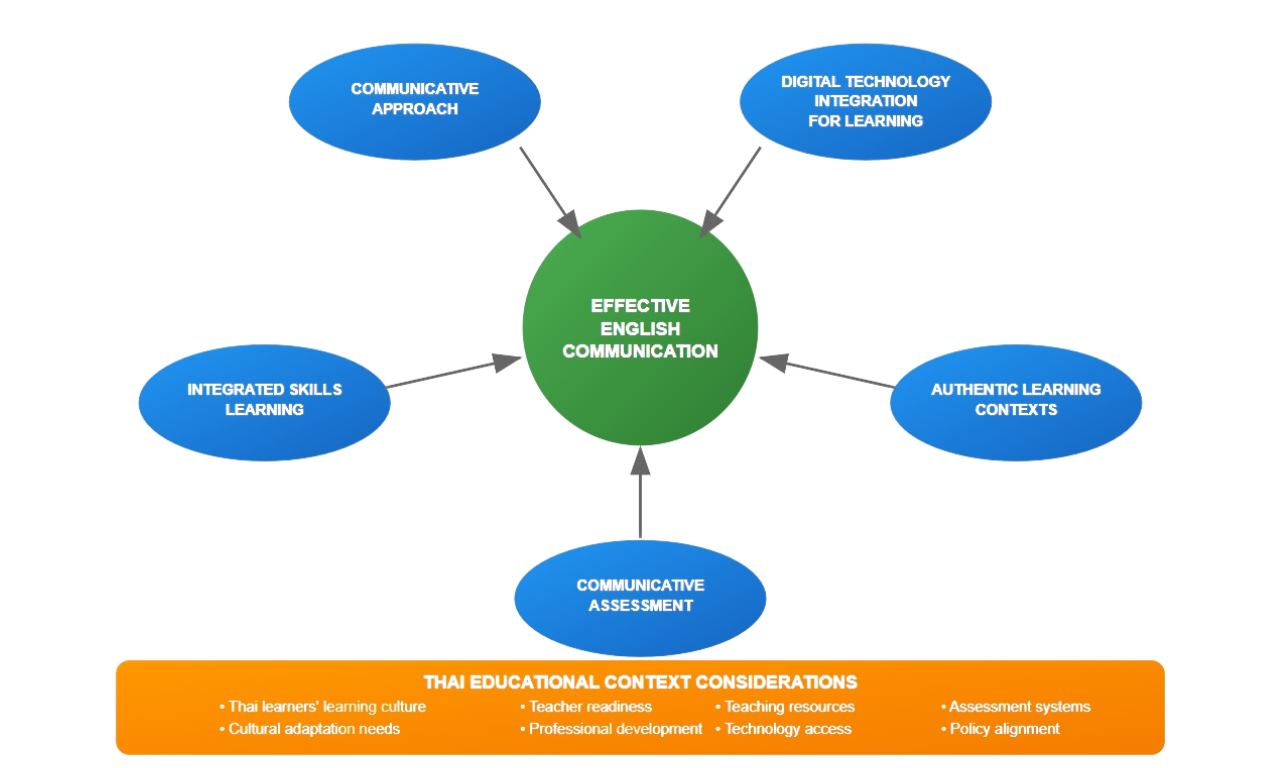
This study aims to investigate approaches for developing English communication skills in the Thai educational context using documentary research methodology. Data were collected and analyzed from academic documents, research articles, and secondary sources related to English for communication teaching and learning. The study compiled data from various academic databases between 2019-2024, totaling 85 documents. Data analysis employed content analysis and document synthesis methods. The findings revealed that effective approaches for developing English communication skills comprise five main approaches: 1) Communicative Approach, 2) Digital Technology Integration for Learning, 3) Integrated Skills Learning, 4) Authentic Learning Contexts, and 5) Communicative Assessment. This study provides recommendations for curriculum development and English teaching methods focusing on communication in the Thai context. The research contributes valuable insights for educators, teachers, and policymakers in developing effective curricula and teaching methodologies that emphasize practical communication skills, ultimately enhancing the quality of English language education in Thailand and preparing Thai learners to compete effectively on the global stage.
References
Bachman, L. F., & Palmer, A. S. (2010). Language assessment in practice: Developing language assessments and justifying their use in the real world. Oxford University Press.
Brown, H. D. (2004). Language assessment: Principles and classroom practices. Pearson Education.
Brown, H. D., & Abeywickrama, P. (2019). Language assessment: Principles and classroom practices (3rd ed.). Pearson Education.
Chapelle, C. A., & Sauro, S. (Eds.). (2017). The handbook of technology and second language teaching and learning. Wiley Blackwell.
Choomthong, D. (2014). Preparing Thai students' English for the ASEAN Economic Community: Some pedagogical implications and trends. Language Education and Acquisition Research Network Journal, 7(1), 45-57.
Education First. (2023). EF English Proficiency Index 2023. Education First Ltd.
Foley, J. A. (2005). English in Thailand. RELC Journal, 36(2), 223-234. https://doi.org/10.1177/0033688205055577
Gilmore, A. (2007). Authentic materials and authenticity in foreign language learning. Language Teaching, 40(2), 97-118. https://doi.org/10.1017/S0261444807004144
Godwin-Jones, R. (2019). Riding the digital wilds: Learner autonomy and informal language learning. Language Learning & Technology, 23(1), 8-25. https://doi.org/10.125/44667
Guariento, W., & Morley, J. (2001). Text and task authenticity in the EFL classroom. ELT Journal, 55(4), 347-353. https://doi.org/10.1093/elt/55.4.347
Hinkel, E. (2006). Current perspectives on teaching the four skills. TESOL Quarterly, 40(1), 109-131. https://doi.org/10.2307/40264513
Hubbard, P. (2013). Making a case for learner training in technology enhanced language learning environments. CALICO Journal, 30(2), 163-178. https://doi.org/10.11139/cj.30.2.163-178
Kam, H. W. (2004). English language teaching in East Asia today: An overview. Eastern Universities Press.
Lai, C., & Zheng, D. (2018). Self-directed use of mobile devices for language learning beyond the classroom. ReCALL, 30(3), 299-318. https://doi.org/10.1017/S0958344017000258
Littlewood, W. (2013). Developing a context-sensitive pedagogy for communication-oriented language teaching. English Teaching, 68(3), 3-25.
McNamara, T. (2000). Language testing. Oxford University Press.
Mishan, F. (2005). Designing authenticity into language learning materials. Intellect Books.
Moorhouse, B. L. (2020). Adaptations to a face-to-face initial teacher education course 'forced' online due to the COVID-19 pandemic. Journal of Education for Teaching, 46(4), 609-611. https://doi.org/10.1080/02607476.2020.1755205
Nunan, D. (2004). Task-based language teaching. Cambridge University Press.
Oxford, R. L. (2001). Integrated skills in the ESL/EFL classroom. ERIC Digest. ERIC Clearinghouse on Languages and Linguistics. https://www.ericdigests.org/2002-2/esl.htm
Richards, J. C. (2006). Communicative language teaching today. Cambridge University Press.
Savignon, S. J. (2017). Communicative competence: Theory and classroom practice (4th ed.). McGraw-Hill Education.
Tatsuki, D. (2006). What is authenticity? In D. Tatsuki (Ed.), Authentic materials in language teaching (pp. 7-18). JALT Publications.
Wiriyachitra, A. (2002). English language teaching and learning in Thailand in this decade. Thai TESOL Focus, 15(1), 4-9.
Wongkitrungrueng, A., & Assavajumroon, N. (2020). The challenge of implementing communicative language teaching in Thai secondary schools. PASAA: A Journal of Language Teaching and Learning, 59, 191-221.
Downloads
Published
How to Cite
Issue
Section
License
Copyright (c) 2025 Journal of Applied Humanities Studies

This work is licensed under a Creative Commons Attribution 4.0 International License.
Published articles are copyrighted by the Journal of Applied Humanities Studies.
The contents of each article in this academic journal represent the personal opinions of the individual authors and are not affiliated with the Journal of Applied Humanities Studies or any other editorial team within the publishing house. The responsibility for all content of each article rests with the individual authors. Any errors or omissions are solely the responsibility of each individual author.