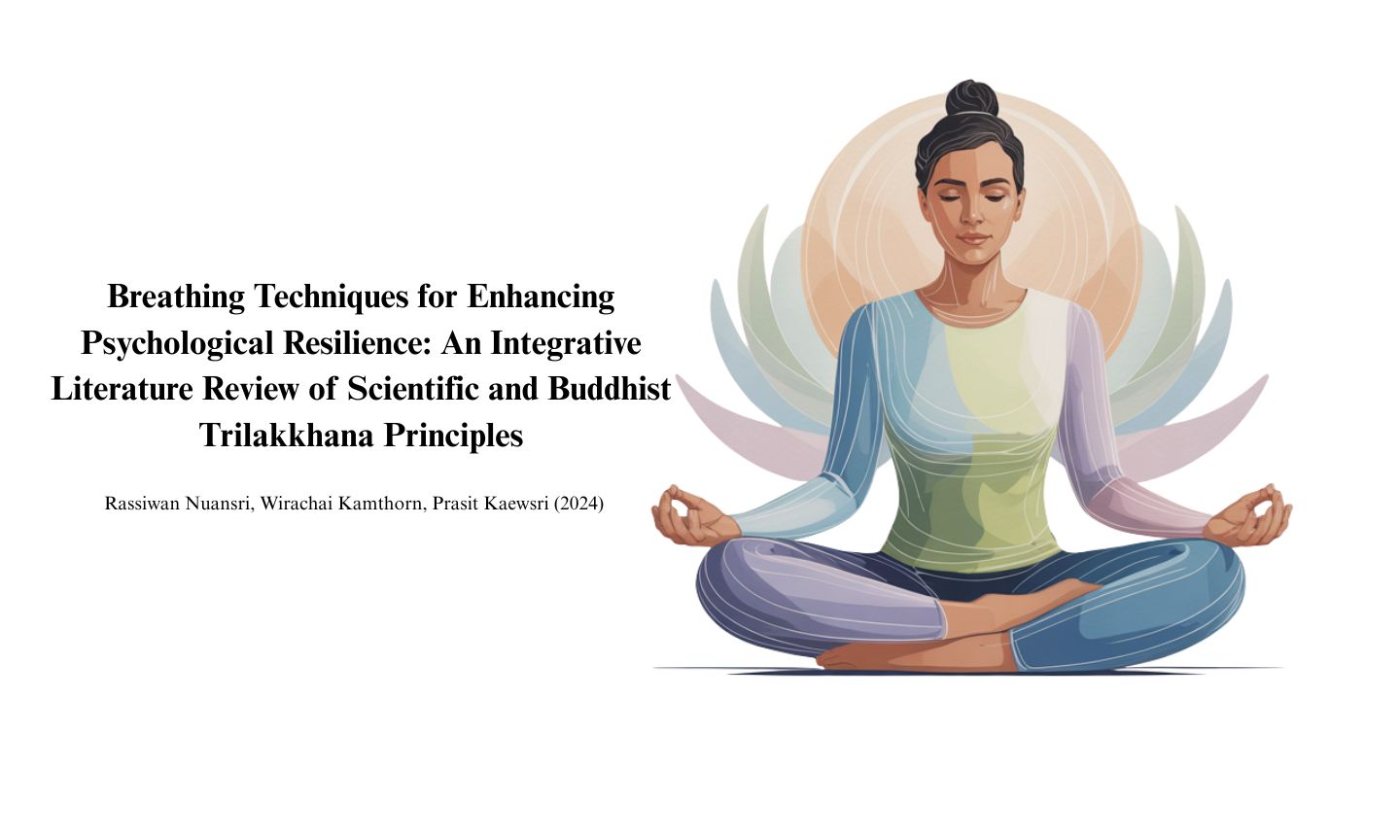
Breathing Techniques for Enhancing Psychological Resilience: An Integrative Literature Review of Scientific and Buddhist Trilakkhana Principles
DOI:
https://doi.org/10.65680/jahs.v2i2.7159Keywords:
Psychological resilience, breathing techniques, Trilakkhana, heart rate variability, Buddhist psychologyAbstract
This integrative literature review aims to explore the connections between modern scientific breathing techniques and Buddhist principles in enhancing psychological resilience. Through analysis of biological and psychological mechanisms related to breathing, including the application of Trilakkhana principles in developing psychological resilience. From the compilation of research articles, five main breathing techniques effective for psychological resilience were summarized: cyclic sighing, resonance frequency breathing, mindfulness of breathing (Anapanasati), box breathing, and diaphragmatic breathing. All techniques affect the improvement of Heart Rate Variability (HRV), creation of autonomic nervous system balance, and development of emotional regulation abilities. The connection with Trilakkhana principles shows that Anicca (impermanence), Dukkha (suffering), and Anatta (non-self) can serve as an effective conceptual framework for building psychological resilience through breathing practice. The application of breathing techniques can be used in various contexts, from crisis situations, education, workplace settings, to public health systems. The integration between modern science and religious principles opens opportunities for developing effective and comprehensive approaches to creating sustainable psychological resilience.
References
Analayo, B. (2003). Satipatthana: The direct path to realization. Windhorse Publications.
Balban, M. Y., Neri, E., Kogon, M. M., Weed, L., Nouriani, B., Jo, B., Holl, G., Zeitzer, J. M., Spiegel, D., & Huberman, A. D. (2023). Brief structured respiration practices enhance mood and reduce physiological arousal. Cell Reports Medicine, 4(1), 100895. https://doi.org/10.1016/j.xcrm.2022.100895
Beauchaine, T. P., & Thayer, J. F. (2015). Heart rate variability as a transdiagnostic biomarker of psychopathology. International Journal of Psychophysiology, 98(2), 338-350. https://doi.org/10.1016/j.ijpsycho.2015.08.004
Bentley, T. G. K., D'Andrea-Penna, G., Rakic, M., Arce, N., LaFaille, M., Berman, R., Cooley, K., & Sprimont, P. (2023). Breathing practices for stress and anxiety reduction: Conceptual framework of implementation guidelines based on a systematic review of the published literature. Brain Sciences, 13(12), 1612. https://doi.org/10.3390/brainsci13121612
Brewer, J. A., Worhunsky, P. D., Gray, J. R., Tang, Y.-Y., Weber, J., & Kober, H. (2011). Meditation experience is associated with differences in default mode network activity and connectivity. Proceedings of the National Academy of Sciences of the United States of America, 108(50), 20254-20259. https://doi.org/10.1073/pnas.1112029108
DeGraves, B. S., Titley, H., Duan, Y., Thorne, T. E., Banerjee, S., Ginsburg, L., Salma, J., Hegadoren, K., Angel, C., Keefe, J., Lanius, R., & Estabrooks, C. A. (2024). Workforce resilience supporting staff in managing stress: A coherent breathing intervention for the long-term care workforce. Journal of the American Geriatrics Society, 72(3), 753-766. https://doi.org/10.1111/jgs.18727
Desbordes, G., Negi, L. T., Pace, T. W. W., Wallace, B. A., Raison, C. L., & Schwartz, E. L. (2012). Effects of mindful-attention and compassion meditation training on amygdala response to emotional stimuli in an ordinary, non-meditative state. Frontiers in Human Neuroscience, 6, 292. https://doi.org/10.3389/fnhum.2012.00292
Fincham, G. W., Strauss, C., Montero-Marin, J., & Cavanagh, K. (2023). Effect of breathwork on stress and mental health: A meta-analysis of randomised-controlled trials. Scientific Reports, 13(1), 432. https://doi.org/10.1038/s41598-022-27247-y
Fletcher, D., & Sarkar, M. (2013). Psychological resilience: A review and critique of definitions, concepts, and theory. European Psychologist, 18(1), 12-23. https://doi.org/10.1027/1016-9040/a000124
Gerritsen, R. J. S., & Band, G. P. H. (2018). Breath of life: The respiratory vagal stimulation model of contemplative activity. Frontiers in Human Neuroscience, 12, 397. https://doi.org/10.3389/fnhum.2018.00397
Hehr, A., Iadipaolo, A. S., Morales, A., Cohen, C., Taub, J. W., Harper, F. W. K., Goldberg, E., Bluth, M. H., Rabinak, C. A., & Marusak, H. A. (2022). Meditation reduces brain activity in the default mode network in children with active cancer and survivors. Pediatric Blood & Cancer, 69(10), e29917. https://doi.org/10.1002/pbc.29917
Hölzel, B. K., Carmody, J., Vangel, M., Congleton, C., Yerramsetti, S. M., Gard, T., & Lazar, S. W. (2011). Mindfulness practice leads to increases in regional brain gray matter density. Psychiatry Research, 191(1), 36-43. https://doi.org/10.1016/j.pscychresns.2010.08.006
Kepenek-Varol, B., Zeren, M., Dinçer, R., & Erkaya, S. (2022). Breathing and relaxation exercises help improving fear of COVID-19, anxiety, and sleep quality: A randomized controlled trial. Journal of Integrative and Complementary Medicine, 28(7), 579-586. https://doi.org/10.1089/jicm.2021.0381
Kirk, U., & Axelsen, J. L. (2020). Heart rate variability is enhanced during mindfulness practice: A randomized controlled trial involving a 10-day online-based mindfulness intervention. PLoS One, 15(12), e0243488. https://doi.org/10.1371/journal.pone.0243488
Kurdziel, L., McDevitt, L., & Hardway, C. (2025). Acute effects of slow-paced breathing on emotion regulation: A pilot study. Psychological Reports, 134(1), 332941251329856. https://doi.org/10.1177/00332941251329856
Laborde, S., Mosley, E., & Thayer, J. F. (2017). Heart rate variability and cardiac vagal tone in psychophysiological research—Recommendations for experiment planning, data analysis, and data reporting. Frontiers in Psychology, 8, 213. https://doi.org/10.3389/fpsyg.2017.00213
Ma, X., Yue, Z.-Q., Gong, Z.-Q., Zhang, H., Duan, N.-Y., Shi, Y.-T., Wei, G.-X., & Li, Y.-F. (2017). The effect of diaphragmatic breathing on attention, negative affect and stress in healthy adults. Frontiers in Psychology, 8, 874. https://doi.org/10.3389/fpsyg.2017.00874
Marchant, J., Khazan, I., Cressman, M., & Steffen, P. (2025). Comparing the effects of square, 4-7-8, and 6 breaths-per-minute breathing conditions on heart rate variability, CO2 levels, and mood. Applied Psychophysiology and Biofeedback, 50(2), 261-276. https://doi.org/10.1007/s10484-025-09688-z
Morgan, S. P., Lengacher, C. A., & Seo, Y. (2024). A systematic review of breathing exercise interventions: An integrative complementary approach for anxiety and stress in adult populations. Journal of Holistic Nursing, 42(4), 8980101241273860. https://doi.org/10.1177/08980101241273860
Nandarathana, R. N., & Ranjan, J. K. (2024). The application of Theravāda Buddhist meditation practices and techniques in mindfulness-based interventions. Vidyodaya Journal of Humanities and Social Sciences, 9(1). https://journals.sjp.ac.lk/index.php/vjhss/article/view/7424
Resilience Definition. (n.d.). Oxford Learner's Dictionaries. https://www.oxfordlearnersdictionaries.com/definition/english/resilience
Santarnecchi, E., D'Arista, S., Egiziano, E., Gardi, C., Petrosino, R., Vatti, G., Reda, M., & Rossi, A. (2014). Interaction between neuroanatomical and psychological changes after mindfulness-based training. PLoS One, 9(10), e108359. https://doi.org/10.1371/journal.pone.0108359
Shao, R., Man, I. S. C., & Lee, T. M. C. (2024). The effect of slow-paced breathing on cardiovascular and emotion functions: A meta-analysis and systematic review. Mindfulness, 15(1), 1-18. https://doi.org/10.1007/s12671-023-02294-2
Sillevis, R., Weiss, V., & Reuter, P. (2025). Do mindful breathing exercises in the classroom have a positive impact on student anxiety and testing experience? HAPS Educator, 29(1), 5-14. https://doi.org/10.21692/haps.2025.001
Sos, T., & Melton, B. (2024). Comparison of mindfulness practices for effectiveness of stress and burnout reduction in healthcare staff. Journal of Holistic Nursing, 42(4), 333-343. https://doi.org/10.1177/08980101231219304
Steffen, P. R., Austin, T., DeBarros, A., & Brown, T. (2017). The impact of resonance frequency breathing on measures of heart rate variability, blood pressure, and mood. Frontiers in Public Health, 5, 222. https://doi.org/10.3389/fpubh.2017.00222
Tavoian, D., & Craighead, D. H. (2023). Deep breathing exercise at work: Potential applications and impact. Frontiers in Physiology, 14, 1040091. https://doi.org/10.3389/fphys.2023.1040091
Tedeschi, R. G. (2023). The post-traumatic growth approach to psychological trauma. World Psychiatry, 22(2), 328-329. https://doi.org/10.1002/wps.21093
Thayer, J. F., & Lane, R. D. (2009). Claude Bernard and the heart-brain connection: Further elaboration of a model of neurovisceral integration. Neuroscience & Biobehavioral Reviews, 33(2), 81-88. https://doi.org/10.1016/j.neubiorev.2008.08.004
Vagedes, J., Szőke, H., Islam, M., Sobh, M., Kuderer, S., Khazan, I., & Vagedes, K. (2024). Mobile heart rate variability biofeedback for work-related stress in employees and the influence of instruction format (digital or live) on training outcome: A non-randomized controlled trial. Applied Psychophysiology and Biofeedback, 50(1), 79-93. https://doi.org/10.1007/s10484-024-09671-0
Voltmer, K., Hondrich, F., & von Salisch, M. (2023). Daily breath-based mindfulness exercises in a randomized controlled trial improve primary school children's performance in arithmetic. Scientific Reports, 13(1), 22169. https://doi.org/10.1038/s41598-023-49354-0
Wang, Q., Wang, F., Zhang, S., Liu, C., Feng, Y., & Chen, J. (2023). Effects of a mindfulness-based interventions on stress, burnout in nurses: A systematic review and meta-analysis. Frontiers in Psychiatry, 14, 1218340. https://doi.org/10.3389/fpsyt.2023.1218340
Yau, A., & Loke, A. Y. (2021). Effects of diaphragmatic breathing training on anxiety, depression, and stress among pregnant women: A systematic review and meta-analysis. Frontiers in Psychology, 12, 720090. https://doi.org/10.3389/fpsyg.2021.720090
Yilmaz Balban, M., Neri, E., Kogon, M. M., Weed, L., Nouriani, B., Jo, B., Holl, G., Zeitzer, J. M., Spiegel, D., & Huberman, A. D. (2023). Brief structured respiration practices enhance mood and reduce physiological arousal. Cell Reports Medicine, 4(1), 100895. https://doi.org/10.1016/j.xcrm.2022.100895
Zaccaro, A., Piarulli, A., Laurino, M., Garbella, E., Menicucci, D., Neri, B., & Gemignani, A. (2018). How breath-control can change your life: A systematic review on psycho-physiological correlates of slow breathing. Frontiers in Human Neuroscience, 12, 353. https://doi.org/10.3389/fnhum.2018.00353
Zope, S. A., & Zope, R. A. (2013). Sudarshan kriya yoga: Breathing for health. International Journal of Yoga, 6(1), 4-10. https://doi.org/10.4103/0973-6131.105935
Kitti Chittreethinn, Somphochon Aiamsuphasit, & Man Suesoongern. (2021). Effects of Anapanasati practice on reducing anxiety among regular military personnel. Journal of Buddhist Psychology, 6(1), 30-40. https://so03.tci-thaijo.org/index.php/jbp/article/view/251270
Mahachulalongkornrajavidyalaya University. (2016). Tripitaka Volume 10 (Mahachula Edition). https://84000.org/tipitaka/pitaka_item/read_page.php?book=10&page=301&pages=4&edition=mcu
National Suicide Prevention Center. (2024). Report on suicide situation in Thailand, fiscal year 2023. https://suicide.dmh.go.th/news/view.asp?id=92
Phra Nathawutti Phanthalee, Phra Khru Winaitharawornchod Payutto, & Chanatip Sritho. (2021). Anapanasati: The breath of awakening according to Buddhist principles. Journal of Buddhism and Philosophy, 4(2), 1-13.
Phra Promkunaphon (P.A. Payutto). (2017). Dictionary of Buddhism: Comprehensive Dharma Edition (23rd ed.). Mahamakut Rajavidyalaya University Press. https://www.watnyanaves.net/uploads/File/books/pdf/dictionary_of_buddhism_pra-muan-dhaama.pdf
Sombat Siripatanakul. (2022). Anapanasati meditation: Breath contemplation from ordinary person to noble one. Journal of Buddhist Innovation Review, 3(1), 11-20.
Thai Depression Knowledge Center. (2023). Report on depression situation and access to treatment in Thailand. Department of Mental Health, Ministry of Public Health. https://www.thaipbs.or.th/news/content/324887
Thai Health Promotion Foundation. (n.d.). "Resilience Builders: Wellness Recovery Skills" curriculum for medical personnel. https://www.happinessisthailand.com/2022/08/09/resilience-builders/
Warat Chotipityasunon. (2024, March 30). Thai mental health situation and problem-solving approaches. In 2nd National Health Promoting University Academic Conference. https://www.hfocus.org/content/2024/03/30088
Downloads
Published
How to Cite
Issue
Section
License
Copyright (c) 2024 Journal of Applied Humanities Studies

This work is licensed under a Creative Commons Attribution 4.0 International License.
Published articles are copyrighted by the Journal of Applied Humanities Studies.
The contents of each article in this academic journal represent the personal opinions of the individual authors and are not affiliated with the Journal of Applied Humanities Studies or any other editorial team within the publishing house. The responsibility for all content of each article rests with the individual authors. Any errors or omissions are solely the responsibility of each individual author.