Application of Buddhist Psychology in Promoting Emotional Development of Early Childhood: A Documentary Research
DOI:
https://doi.org/10.65680/jahs.v1i2.6923Keywords:
Buddhist psychology, emotional development, early childhood, early childhood education, emotional managementAbstract
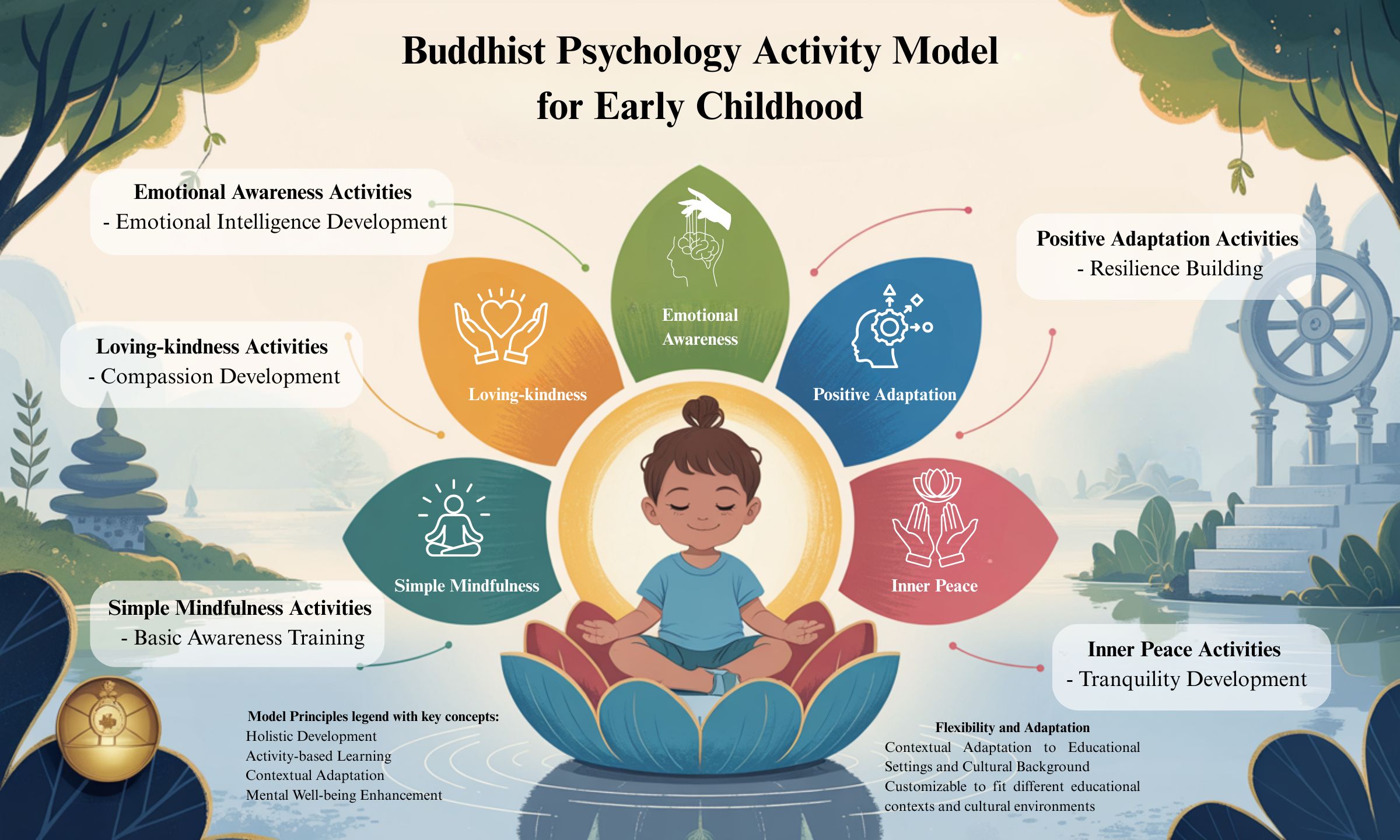
This documentary research aims to study the application of Buddhist psychology in promoting emotional development of early childhood and to synthesize approaches for developing activity models based on Buddhist psychology concepts for early childhood. The researchers collected and analyzed academic documents, research articles, and related theories from both Thai and English databases between 2013-2023, totaling 45 documents. The research findings revealed that Buddhist psychology principles applicable to promoting emotional development in early childhood include mindfulness, emotional awareness, positive adaptation, and loving-kindness. The application of these principles in age-appropriate enjoyable activities affects the development of emotional management skills, self-understanding, and building good relationships with others. Additionally, the integration of Buddhist psychology with early childhood education helps promote mental balance, reduce aggressive behavior, and enhance children's adaptability. This research proposes guidelines for developing curricula and learning activities that integrate Buddhist psychology to sustainably promote emotional development in early childhood.
References
Bodhi, B. (2020). The noble eightfold path: Way to the end of suffering. Buddhist Publication Society.
Chanprasert, S. (2022). Application of mindfulness principles in early childhood development: A case study of demonstration schools. Thai Journal of Early Childhood Education, 15(2), 45–62.
Denham, S. A., & Burton, R. (2003). Social and emotional prevention and intervention programming for preschoolers. Kluwer Academic/Plenum Publishers.
Denham, S. A., Bassett, H. H., Mincic, M., Kalb, S., Way, E., Wyatt, T., & Segal, Y. (2023). Social-emotional learning profiles of preschoolers' early school success: A person-centered approach. Learning and Individual Differences, 101, 102–115.
Flook, L., Goldberg, S. B., Pinger, L., & Davidson, R. J. (2019). Promoting prosocial behavior and self-regulatory skills in preschool children through a mindfulness-based kindness curriculum. Developmental Psychology, 51(1), 44–51.
Goleman, D. (2021). Emotional intelligence: Why it matters more than IQ (25th anniversary ed.). Bantam Books.
Pattanapong, K. (2023). Development of emotional awareness programs for early childhood in Thai context. Journal of Developmental Psychology, 28(1), 78–95.
Rattanaporn, W., & Sirichai, P. (2022). Effects of positive adaptation training on emotional development of kindergarten children. Journal of Education for Social Development, 18(3), 112–128.
Roeser, R. W., & Zelazo, P. D. (2022). Contemplative science, education and child development: Introduction to the special section. Developmental Psychology, 48(3), 672–676.
Schonert-Reichl, K. A., Oberle, E., Lawlor, M. S., Abbott, D., Thomson, K., Oberlander, T. F., & Diamond, A. (2020). Enhancing cognitive and social-emotional development through a simple-to-administer mindfulness-based school program for elementary school children. Developmental Psychology, 51(1), 52–66.
Siegel, D. J. (2022). The developing mind: How relationships and the brain interact to shape who we are (3rd ed.). Guilford Press.
Siripong, M. (2021). Mindfulness principles in early childhood education: Integration approaches toward sustainable development. Journal of Teacher Education, 19(4), 203–218.
Sornlert, N. (2023). Designing mindfulness activities for early childhood: From theory to practice. Journal of Education for Local Development, 12(2), 89–104.
Thanakit, S. (2021). Buddhist psychology and child development: Perspectives from Thai psychologists. Thai Journal of Psychology, 45(3), 156–174.
Thanakorn, R. (2021). Creating inner peace in children through art and play activities. Journal of Art Education, 22(1), 67–83.
Wongkham, L. (2022). Effects of mindfulness training programs on early childhood behavior: An experimental study. Journal of Behavioral Science Research, 14(2), 134–149.
Zelazo, P. D., & Lyons, K. E. (2022). The potential benefits of mindfulness training in early childhood: A developmental social cognitive neuroscience perspective. Child Development Perspectives, 6(2), 154–160.
Downloads
Published
How to Cite
Issue
Section
License
Copyright (c) 2023 Journal of Applied Humanities Studies

This work is licensed under a Creative Commons Attribution 4.0 International License.
Published articles are copyrighted by the Journal of Applied Humanities Studies.
The contents of each article in this academic journal represent the personal opinions of the individual authors and are not affiliated with the Journal of Applied Humanities Studies or any other editorial team within the publishing house. The responsibility for all content of each article rests with the individual authors. Any errors or omissions are solely the responsibility of each individual author.