Enhancing Student Potential in Temple Schools through the Bavorn Concept: Home, Temple, School
DOI:
https://doi.org/10.65680/jahs.v1i2.6921Keywords:
student potential enhancement, temple schools, home-temple-school, Buddhist education, Bavorn conceptAbstract
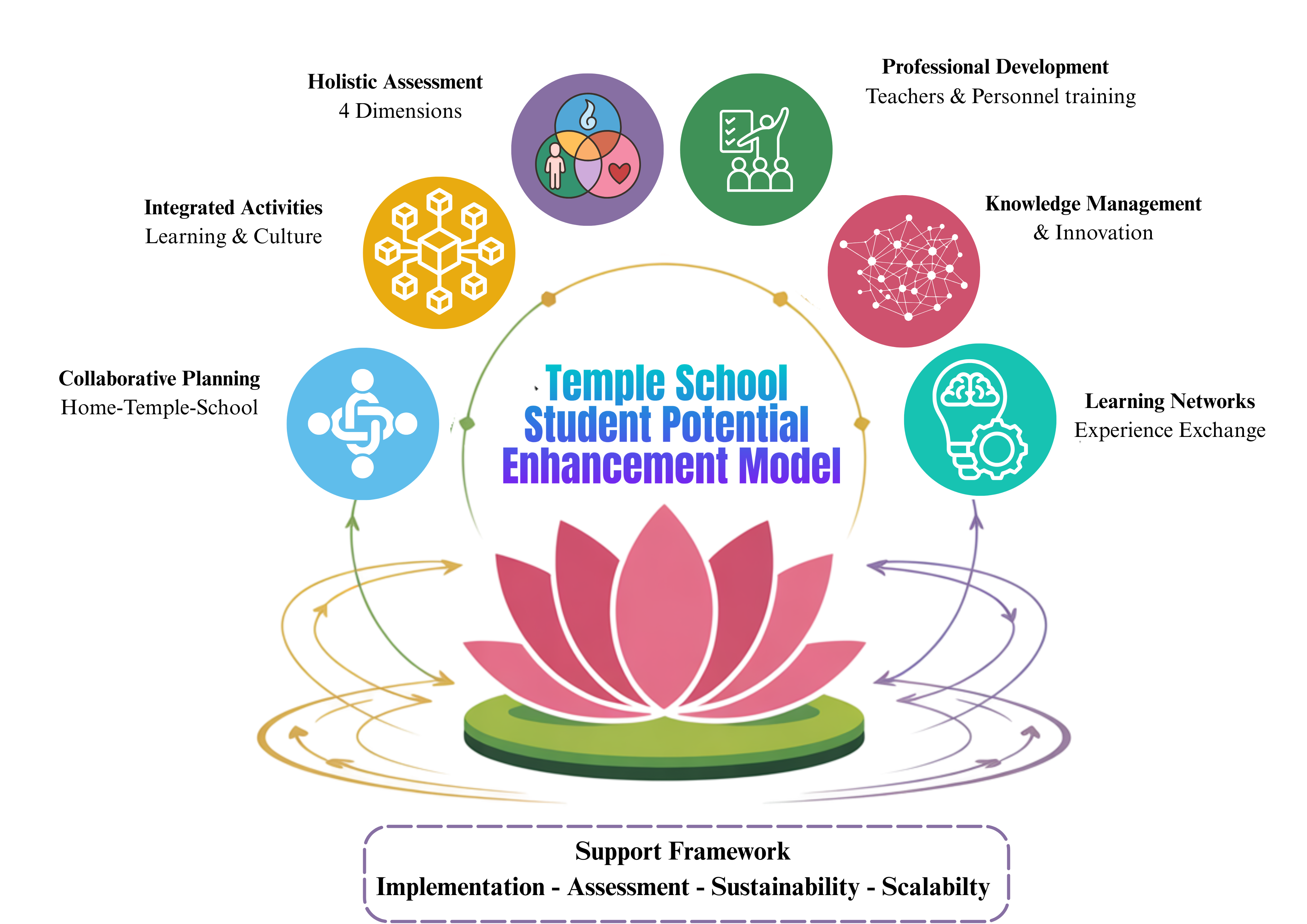
This study aimed to investigate approaches for enhancing student potential in temple schools through the Bavorn concept, which encompasses home, temple, and school, and to develop an appropriate model for enhancing student potential in temple schools that aligns with Thai social context. This qualitative research employed documentary research and in-depth interviews. The informants consisted of 30 individuals including temple school administrators, teachers, monks, parents, and students from temple schools in 5 central provinces. Data were collected between January and March 2023 and analyzed using content analysis. The findings revealed that the Bavorn concept comprising home, temple, and school can effectively enhance student potential across four dimensions: spiritual, social, intellectual, and cultural. The home plays a role in instilling basic moral values, the temple serves as a center for learning dharma and culture, while the school is a place for developing knowledge and skills. An appropriate model consists of four dimensions: spiritual, social, intellectual, and cultural. The integration of these three institutions helps develop students into complete individuals with knowledge, morality, and ethics.
References
Boonchom, S. (1992). Basic research (6th rev. ed.). Suweeriyasarn.
Bureau of Buddhist Education. (2014). Manual for permission application procedures for establishing and expanding classes in Phra Pariyatidhamma schools, general education division. Office of National Buddhism.
Komsan, C. (2015). Bavorn: Home, temple, school - Society of mutual support. Four-Region Slum Network. https://thecitizen.plus/node/5383
Krutkwan, N., Theprenhu, S., & Duangloy, D. (2024). Learning management using learning packages on Buddhist principles in social studies, religion and culture learning area for grade 5 students at Wat Srisuk School (Yaemyuen Upatham) Khlong Sam Wa District, Bangkok. Academic Research Journal, 7(3), 105–116. https://doi.org/10.14456/jra.2024.63
Ministry of Education. (2017). Core curriculum for basic education Buddhist Era 2551 [Revised ed.]. Agricultural Cooperative Assembly of Thailand Printing House.
Phra Krisana Wachiranayano (Waphakdiphetch). (2022). Learning management of Buddhism subject according to the four foundations of mindfulness principle in social studies, religion, and culture learning group at Phra Pariyatidhamma schools, general education division, Kalasin Province. Prim Research Institute Journal, 9(3), 45–62.
Phra Maha Wichan Suwichano (Bavornban), & Kasem, S. (2019). Manual for Buddhist way school operations. Mahachulalongkornrajavidyalaya University Press.
Sanit, A. (2020). Bavorn (home temple school) towards circular economy for sustainability in Bang Kachao community. OUR Khung BangKachao Project. https://www.ourkhungbangkachao.com/th/news/detail/46
Siriporn, Y., et al. (2022). Buddhist education learning management in Thailand 4.0 era for elementary students in Bang Khen District, Bangkok. Panya Journal, 18(2), 134–147.
Supannee, P., et al. (2022). Model development of knowledge and ability and learning resource utilization of teaching staff: A case study of Wat Sothorn Wararam Worawihan School. Journal of Education Thaksin University, 22(1), 89–104.
Uthit, C., et al. (2022). Bavorn power and strengthening communities through Galmor dimension of Gui people in Sri Suk Subdistrict, Samrong Thab District, Surin Province. Journal of Educational Management and Research Innovation, 7(2), 156–172.
Waramont, S., et al. (2022). Conditions and approaches for school administration to develop leading Buddhist way schools of educational institutions under Chiang Mai Primary Educational Service Area Office 4. Sisaket Rajabhat University Academic Journal, 16(3), 78–95.
Wasana, K. (2008). Learning sources for community: A case study of Phanomdonrak medicine from Arokhayasala in Thailand and Cambodia. National Research Council of Thailand Office.
Downloads
Published
How to Cite
Issue
Section
License
Copyright (c) 2023 Journal of Applied Humanities Studies

This work is licensed under a Creative Commons Attribution 4.0 International License.
Published articles are copyrighted by the Journal of Applied Humanities Studies.
The contents of each article in this academic journal represent the personal opinions of the individual authors and are not affiliated with the Journal of Applied Humanities Studies or any other editorial team within the publishing house. The responsibility for all content of each article rests with the individual authors. Any errors or omissions are solely the responsibility of each individual author.