The Use of Language in Encouragement: A Psycholinguistic Perspective
DOI:
https://doi.org/10.65680/jahs.v3i1.6767Keywords:
psycholinguistics, encouragement, positive communication, motivation, mental healthAbstract
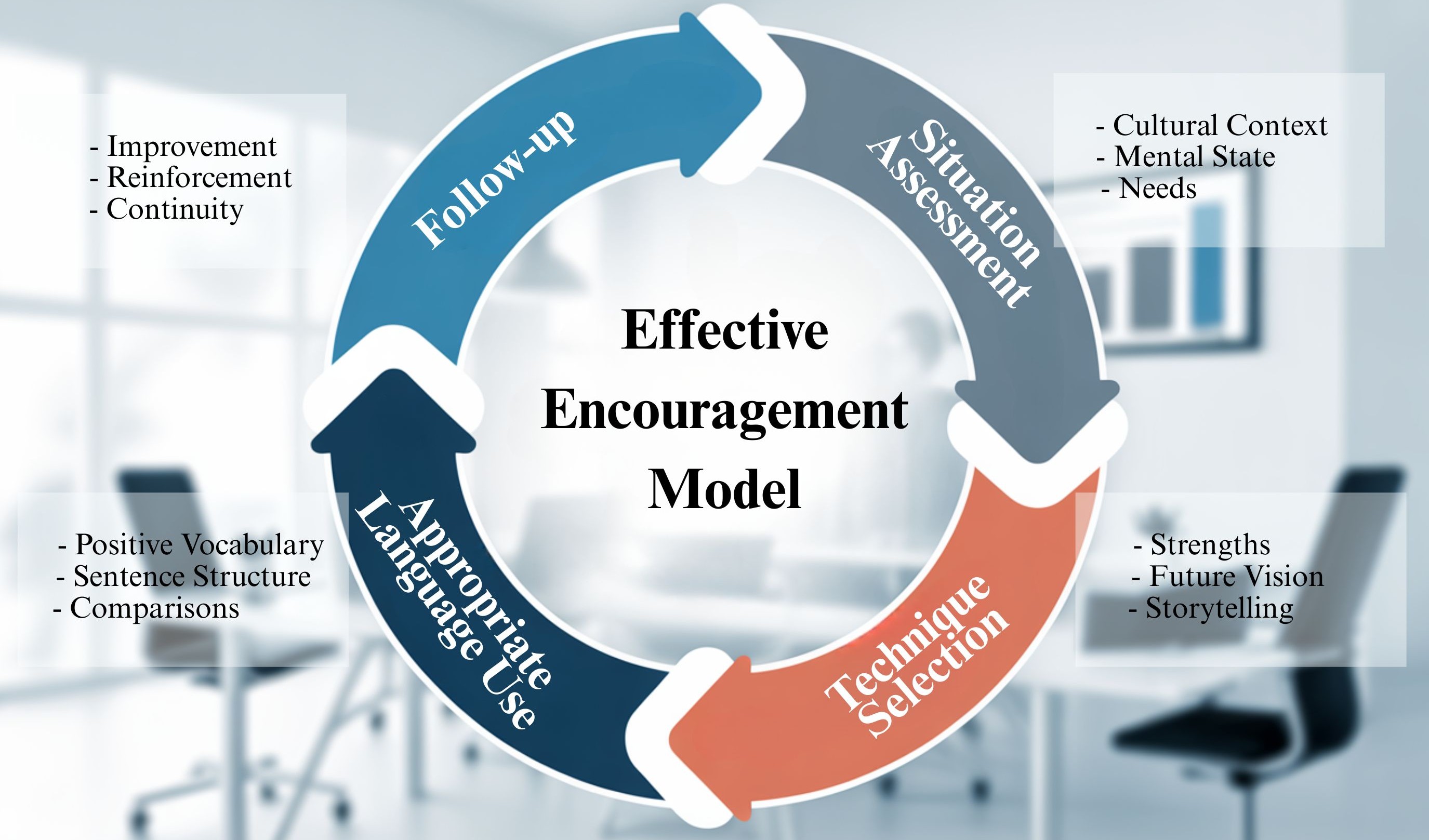
Encouragement through language use is a crucial process in creating motivation and developing mental health. This study focuses on analyzing the use of language in encouragement from a psycholinguistic perspective, exploring linguistic elements that influence the creation of inspiration and hope. The study covers theories of language processing, psychological mechanisms related to the perception of encouraging words, and impacts on behavioral and attitudinal changes. The findings reveal that effective encouragement language structure comprises four main components: the use of positive vocabulary, creation of mental imagery, connection with personal experiences, and creation of a sense of ownership. Additionally, cultural and situational contexts significantly influence the effectiveness of language used in encouragement. This study is important for developing effective communication strategies in counseling, education, and psychological treatment.
References
Derakhshan, A., Kruk, M., Mehdizadeh, M., & Pawlak, M. (2021). Boredom in online classes in the Iranian EFL context: Sources and solutions. System, 101, Article 102556. https://doi.org/10.1016/j.system.2021.102556
Dewaele, J. M., Chen, X., Padilla, A. M., & Lake, J. (2019). The flowering of positive psychology in foreign language teaching and acquisition research. Frontiers in Psychology, 10, Article 2128. https://doi.org/10.3389/fpsyg.2019.02128
Dörnyei, Z. (2003). Attitudes, orientations, and motivations in language learning: Advances in theory, research, and applications. Language Learning, 53, 3–32. https://doi.org/10.1111/1467-9922.53222
Dörnyei, Z. (2005). The psychology of the language learner: Individual differences in second language acquisition. Lawrence Erlbaum Associates.
Dörnyei, Z., & Ryan, S. (2015). The psychology of the language learner revisited. Routledge.
Dörnyei, Z., & Ushioda, E. (2011). Teaching and researching motivation (2nd ed.). Pearson Education.
Gardner, R. C. (1985). Social psychology and second language learning: The role of attitudes and motivation. Edward Arnold.
Gardner, R. C. (2010). Motivation and second language acquisition: The socio-educational model. Peter Lang.
Hiver, P., & Al-Hoorie, A. H. (2020). Reexamining the role of vision in second language motivation: A preregistered conceptual replication of You, Dörnyei, and Csizér (2016). Language Learning, 70, 48–102. https://doi.org/10.1111/lang.12371
Howard, J. L., Bureau, J., Guay, F., Chong, J. X., & Ryan, R. M. (2021). Student motivation and associated outcomes: A meta-analysis from self-determination theory. Perspectives on Psychological Science, 16(6), 1300–1323. https://doi.org/10.1177/1745691620966789
MacIntyre, P. D. (2016). So far so good: An overview of positive psychology and its contributions to SLA. In D. Gabryś-Barker & D. Gałajda (Eds.), Positive psychology perspectives on foreign language learning and teaching (pp. 3–20). Springer.
MacIntyre, P. D., & Gregersen, T. (2012). Emotions that facilitate language learning: The positive-broadening power of the imagination. Studies in Second Language Learning and Teaching, 2(2), 193–213. https://doi.org/10.14746/ssllt.2012.2.2.4
MacIntyre, P. D., Gregersen, T., & Mercer, S. (2016). Positive psychology in SLA. Multilingual Matters.
MacIntyre, P. D., & Mercer, S. (2014). Introducing positive psychology to SLA. Studies in Second Language Learning and Teaching, 4(2), 153–172. https://doi.org/10.14746/ssllt.2014.4.2.2
Miller, W. R., & Rollnick, S. (2013). Motivational interviewing: Helping people change (3rd ed.). Guilford Press.
Niemiec, R. M. (2013). VIA character strengths: Research and practice (The first 10 years). In H. H. Knoop & A. Delle Fave (Eds.), Well-being and cultures: Perspectives on positive psychology (pp. 11–29). Springer.
Pei, R., & Zhang, Z. (2023). Researching language learning motivation: A concise guide. Frontiers in Psychology, 13, Article 1107594. https://doi.org/10.3389/fpsyg.2022.1107594
Peterson, C., & Seligman, M. E. P. (2004). Character strengths and virtues: A handbook and classification. Oxford University Press.
Ryan, R. M., & Deci, E. L. (2020). Intrinsic and extrinsic motivation from a self-determination theory perspective: Definitions, theory, practices, and future directions. Contemporary Educational Psychology, 61, Article 101860. https://doi.org/10.1016/j.cedpsych.2020.101860
Sahli, H., Haddad, M., Jebabli, N., Sahli, F., Ouergui, I., Ouerghi, N., Bragazzi, N. L., & Zghibi, M. (2022). The effects of verbal encouragement and compliments on physical performance and psychophysiological responses during the repeated change of direction test. Frontiers in Psychology, 12, Article 698673. https://doi.org/10.3389/fpsyg.2021.698673
Seligman, M. E. P. (2011). Flourish: A visionary new understanding of happiness and well-being. Free Press.
Seligman, M. E. P., & Csikszentmihalyi, M. (2000). Positive psychology: An introduction. American Psychologist, 55(1), 5–14. https://doi.org/10.1037/0003-066X.55.1.5
Shi, B. (2023). Psychological impact of languages on the human mind: Research on the contribution of psycholinguistics approach to teaching and learning English. Journal of Psycholinguistic Research, 52(6), 2027–2045. https://doi.org/10.1007/s10936-023-09977-w
Skinner, E. A., Kindermann, T. A., & Furrer, C. J. (2009). A motivational perspective on engagement and disaffection: Conceptualization and assessment of children's behavioral and emotional participation in academic activities in the classroom. Educational Psychology Measurement, 69, 493–525. https://doi.org/10.1177/0013164408323233
Wang, Y., Derakhshan, A., & Zhang, L. (2021). Researching and practicing positive psychology in second/foreign language learning and teaching: The past, current status and future directions. Frontiers in Psychology, 12, Article 731721. https://doi.org/10.3389/fpsyg.2021.731721
Wiek, A., Withycombe, L., & Redman, C. L. (2011). Key competencies in sustainability: A reference framework for academic program development. Sustainability Science, 6(2), 203–218. https://doi.org/10.1007/s11625-011-0132-6
Wong, Y. J. (2015). The psychology of encouragement: Theory, research, and applications. The Counseling Psychologist, 43(2), 178–216. https://doi.org/10.1177/0011000014545091
Yin, H., & Lee, J. C. K. (2012). Be passionate, but be rational as well: Emotional rules for Chinese teachers' work. Teaching and Teacher Education, 28(1), 56–65. https://doi.org/10.1016/j.tate.2011.08.005
Zhang, L. J. (2020). A bibliometric analysis of second language acquisition between 1997 and 2018. Studies in Second Language Acquisition, 42(1), 199–222. https://doi.org/10.1017/S0272263119000573
Downloads
Published
How to Cite
Issue
Section
License
Copyright (c) 2025 Journal of Applied Humanities Studies

This work is licensed under a Creative Commons Attribution 4.0 International License.
Published articles are copyrighted by the Journal of Applied Humanities Studies.
The contents of each article in this academic journal represent the personal opinions of the individual authors and are not affiliated with the Journal of Applied Humanities Studies or any other editorial team within the publishing house. The responsibility for all content of each article rests with the individual authors. Any errors or omissions are solely the responsibility of each individual author.