Sufficiency Economy Philosophy: A Management Framework for Modern Executives
DOI:
https://doi.org/10.65680/jahs.v1i1.6641Keywords:
Sufficiency Economy Philosophy, management, modern executives, sustainable development, conceptual frameworAbstract
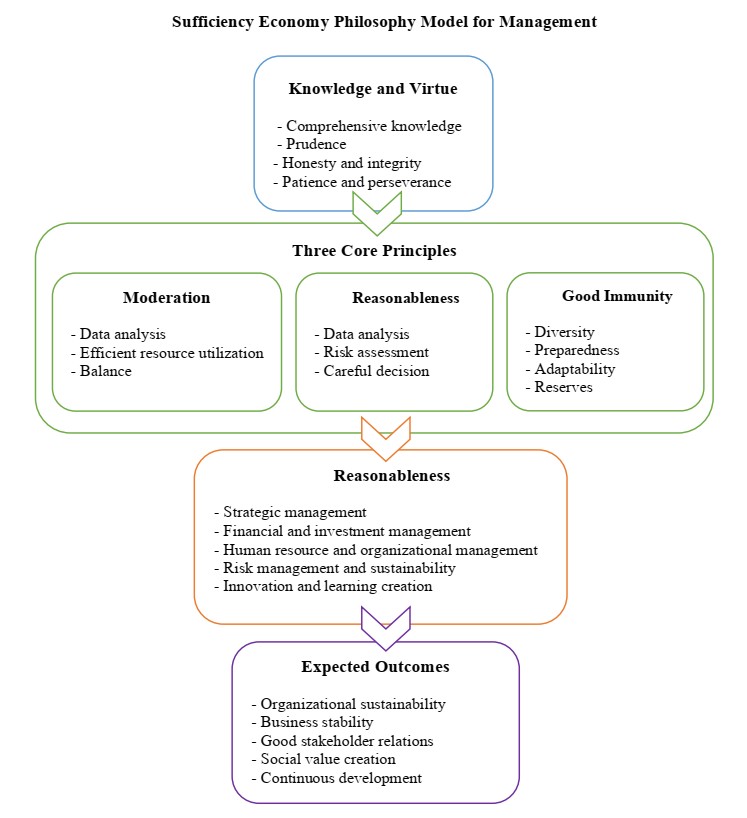
The Sufficiency Economy Philosophy, graciously bestowed by His Majesty King Bhumibol Adulyadej The Great as a guideline for sustainable development, has become an important framework for management in the current era. This article aims to study the application of the Sufficiency Economy Philosophy principles in modern organizational management and propose a conceptual framework for implementation by contemporary executives. This study employs qualitative research methods through literature review, in-depth interviews with executives who have successfully applied the Sufficiency Economy Philosophy, and case studies from various organizations. The findings reveal that the Sufficiency Economy Philosophy can be effectively applied in management, particularly in strategic planning, risk management, organizational sustainability development, and building strong organizational culture. This article presents a model for applying the Sufficiency Economy Philosophy for modern executives, consisting of three core principles: moderation, reasonableness, and good immunity, along with the essential conditions of knowledge and virtue. Implementing these principles will help organizations adapt and grow sustainably amidst the changes and uncertainties of today's business environment.
References
Avihingsanon, Y. (2021). Challenges in implementing sufficiency economy philosophy in modern organizations. Asian Business Review, 12(3), 45–62.
Christensen, L. J., Mackey, A., & Whetten, D. (2021). Taking responsibility for corporate social responsibility: The role of leaders in creating, implementing, sustaining, or avoiding socially responsible firm behaviors. Academy of Management Perspectives, 35(2), 87–112.
Kantabutra, S. (2021). Sufficiency economy philosophy: Thailand's path toward sustainable development. International Journal of Sustainable Development, 24(1–2), 123–145.
Mongsawad, P. (2021). The philosophy of sufficiency economy: A contribution to the theory of development. Asian-Pacific Economic Literature, 24(2), 67–83.
Office of the National Economic and Social Development Council. (2021). The 13th National Economic and Social Development Plan (2023–2027). Office of the Prime Minister.
Piboolsravut, P. (2021). Sufficiency economy philosophy and sustainable development: Thailand's alternative development path. ASEAN Economic Bulletin, 28(1), 102–119.
Porter, M. E., & Kramer, M. R. (2011). Creating shared value: How to reinvent capitalism—and unleash a wave of innovation and growth. Harvard Business Review, 89(1–2), 62–77.
Royal Speech of His Majesty King Bhumibol Adulyadej. (1999). Sufficiency economy philosophy. Office of the National Economic and Social Development Council.
Tisdell, C. (2020). Sustainability and the sufficiency economy philosophy: Thailand's agricultural development strategies and policies. Agricultural Economics, 51(4), [page numbers incomplete in original].
Wibulswasdi, C., Piboolsravut, P., & Pootrakool, K. (2010). Sufficiency economy philosophy and development. Sufficiency Economy Research Project, Bureau of the Crown Property.
Downloads
Published
How to Cite
Issue
Section
License
Copyright (c) 2023 Journal of Applied Humanities Studies

This work is licensed under a Creative Commons Attribution 4.0 International License.
Published articles are copyrighted by the Journal of Applied Humanities Studies.
The contents of each article in this academic journal represent the personal opinions of the individual authors and are not affiliated with the Journal of Applied Humanities Studies or any other editorial team within the publishing house. The responsibility for all content of each article rests with the individual authors. Any errors or omissions are solely the responsibility of each individual author.